


Introducing the Electronics RESHAPED USA Program - Additive, Digital and/or 3D Electronics: Process Innovation
The Future of Electronics RESHAPED USA conference and exhibition (10 & 11 JUNE 2026, Mountain View) is set to be the most important event of the year in Silicon Valley focused on additive, hybrid, 3D, sustainable, wearable, soft and textile electronics. Hosted at the iconic Computer History Museum, this event serves as the global hub for the next generation of electronics.
This year the program features a world-class agenda with over 75 superb invited talks from around the world, 8 industry- or expert-led masterclasses, 2 tours, and over 75 onsite exhibitors.
In this article, we discuss and highlight various innovative talks at the event around the theme of Additive, Digital and/or 3D Electronics: Process Innovation. In other articles we cover themes like materials innovation, additive electronics in packaging and PCBs, wearables and sensors, soft robotics, additive electronics in packaging and PCB production, sustainable electronics, and more.
Explore the full agenda now and join the global industry in Mountain View on 10 & 11 JUNE 2026. Let us RESHAPE the Future of Electronics together, making it Additive, Hybrid, 3D, R2R, Soft, Flexible, Wearable, Textile and Sustainable.
🚨Explore the Full Agenda and Register before 3 May when early bird rates expire

Lockheed Martin – Paul Gaylo discusses enabling high-temperature antennas with additive manufacturing. Paul explores why material availability alone fails to solve high-temperature design, as traditional fabrication cannot accommodate the tight tolerances and robust joints required for 1,000°C environments. The talk demonstrates how AM creates complex geometries and embedded multi-material interfaces impossible to achieve by traditional means. This work offers a production path for high-performance antennas that thrive in extreme heat.
Fabric8Labs – Michael Matthews highlights Electrochemical Additive Manufacturing (ECAM) for AI thermal management. Michael explores the physical limits of traditional liquid cooling as AI accelerators push heat flux densities beyond 4 W/mm². ECAM deposits pure copper atom-by-atom at room temperature with micron-scale precision, creating pixelated micro-electrode arrays. This technology offers a sustainable pathway to solve the AI thermal bottleneck with a 90% lower GHG footprint than traditional 3D printing.
NASA Marshall Space Flight Center – Cadre Francis explores in-space manufacturing of functional electronic components. Cadre explores the major challenges of fine-feature printing without gravity-assisted flow and maintaining device reliability across diverse space environments. The work investigates how material formulation and deposition behavior evolve
🚨Explore the Full Agenda and Register before 3 May when early bird rates expire

👉 Universal Display Corporation – Mike Hack introduces Universal Vapor Jet Printing (UVJP) as a transformative dry deposition technology. Mike explores the sustainability and efficiency drain caused by manufacturing workflows that depend heavily on solvents and complex lithography. UVJP enables the digital, solvent-free deposition of high-value functional materials at low temperatures. This solution unlocks the fabrication of devices previously unattainable, facilitating cleaner and more intelligent manufacturing.
👉 Sakuu – Robert Bagheri discusses reinventing battery manufacturing with high-speed additive manufacturing. Robert explores the energy-intensive and toxic nature of "wet coating" electrode processes, which suffer from low reliability and high carbon footprints. By combining material preprocessing with dry electrode printing, Sakuu eliminates "forever chemicals" and toxic solvents. This work offers a revolutionary step for solid-state battery production, allowing for arbitrary shapes and integrated safety features at high volume.
👉 Inuru – Marcin Ratajczak discusses affordable surface lighting through printed OLED technology. Marcin explores the "hard economical reality" where OLEDs remain expensive due to vacuum evaporation processes and complex driving electronics. Inuru has simplified OLED manufacturing by utilizing inkjet technology to print molecules on-demand like color. This additive solution saves material, reduces costs, and opens the printed electronics industry to a wider audience through nano-meter precision lighting.
🚨Explore the Full Agenda and Register before 3 May when early bird rates expire
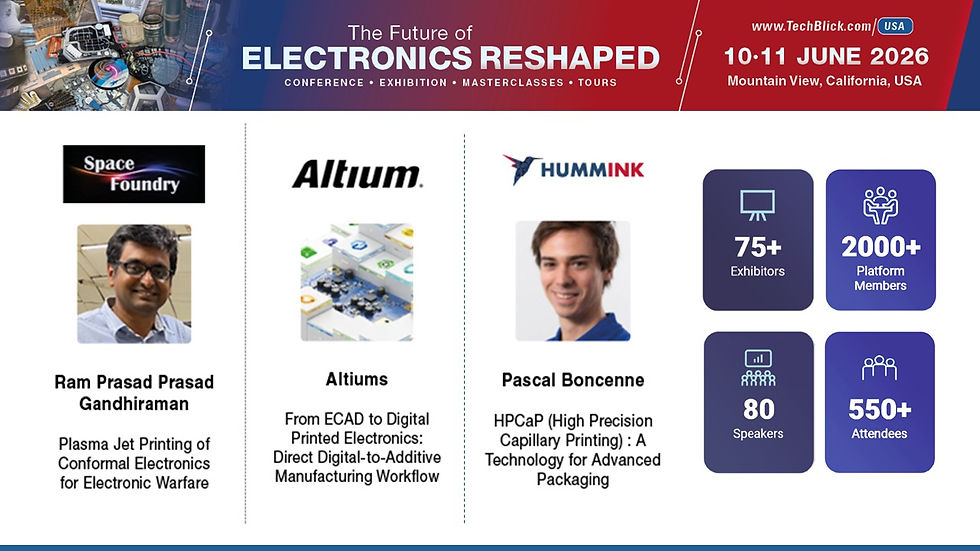
Space Foundry – Ram Prasad Gandhiraman explores plasma jet printing of conformal electronics. Ram explores the difficulty of embedding electronics onto non-planar surfaces like UAV wing panels and nose cones using conventional planar manufacturing. Plasma jet printing is a gravity-independent direct-write technology that uses electromagnetic fields to deliver fluid and reduce metal ions in-situ. This solution provides a fastest-method for addressing evolving electronic warfare environments by printing directly onto complex airborne structures.
Altium discusses a new vision for agile electronics development via the cloud. Altium explores how traditional hardware development workflows are too rigid and slow to keep up with global supply chain chaos and rising demand for embedded tech. By leveraging AI for requirements and a shared cloud platform, cross-functional teams can work in sync. This solution offers an agile hardware development framework that tames requirement chaos and accelerates the path from concept to manufacture.
Hummink – Pascal Boncenne introduces High Precision Capillary Printing (HPCaP) for advanced packaging. Pascal explores the resolution barriers of conventional printing, which often requires external energy sources like UV or lasers that can damage sensitive materials. HPCaP leverages capillary forces and resonance to deposit materials with resolutions down to 100 nanometers. This solution offers a versatile and sustainable method for printing high-viscosity materials on complex substrate topographies in real-time.
🚨Explore the Full Agenda and Register before 3 May when early bird rates expire

Scrona – Patrick Galliker presents a masterclass on Electrohydrodynamic (EHD) inkjet printing. Patrick explores the physics behind EHD and why traditional inkjet struggles with the high-efficiency printing of complex 3D structures. The session details the control of characteristic variables that influence the EHD process at a fundamental level. This work offers an outlook on the commercialization of EHD printheads, showcasing their influence on next-generation high-resolution 3D applications.
Rice University – Yong Lin Kong explores near-field microwave 3D printing of electronics. Yong Lin explores a critical limitation in 3D printing: the inability to selectively anneal printed materials without damaging temperature-sensitive substrates. By focusing microwaves using a metamaterial-inspired near-field structure (Meta-NFS), rapid volumetric heating is achieved in situ. This solution enables the local programming of electronic properties even within optically opaque materials, broadening the compatible material palette.
Oregon State University – Harish Subbaraman highlights plasma-assisted processing for surface property tuning. Harish explores the inefficiency of current three-step printing processes (pretreat, print, sinter), which increase material waste and overall costs. Plasma-jet printing (PJP) reduces these steps into a single on-demand process capable of patterning sub-micron features. This hybrid method offers a transformative pathway for flexible electronics, improving scalability and reliability while reducing costs.
🚨Explore the Full Agenda and Register before 3 May when early bird rates expire

New Mexico State University – Chaitanya Mahajan discusses single-step aerosol printing via in-flight plasma reduction. Chaitanya explores why direct printing of metallic inks rarely achieves functional conductivity without post-processing, which restricts use on heat-sensitive substrates. This work integrates deposition and post-processing into a single step, yielding copper resistivities of just 17 µΩ·cm at low temperatures. This solution provides a framework for rapid metallization in space manufacturing and biocompatible coatings.
NanoPrintek – Masoud Mahjouri-Samani highlights ink-free multimaterial dry printing. Masoud explores the polluting supply chain and contaminant issues inherent in traditional ink-based formulation and high-temperature processing. This disruptive technology prints directly from raw materials—including pure rock or semiconductors—generating pure nanoparticles in-situ. This work offers a supply-chain-agnostic, clean ecosystem for printing multifunctional nanocomposite structures on demand.
Akoneer – Tadas Kildusis presents Selective Surface Activation Induced by Laser (SSAIL) for high-density Cu traces. Tadas explores the environmental impact of traditional PCB/FPC production which relies on masks, chemical etching, and high power consumption. SSAIL technology creates 10-25 µm traces on dielectric materials like FR4, PET, and glass. This solution enables novel, sustainable manufacturing methods that eliminate chemical waste while supporting high-throughput semiconductor packaging.
Notion Systems – Simon Rihm concludes with shaping the future of R&D with the n.jet evo inkjet system. Simon explores the technological challenges of replacing current subtractive process chains with additive steps in a way that is simple and efficient. The presentation demonstrates how industrial-standard desktop inkjet systems support R&D on new functional inks and substrates. This work offers a bridge for research teams to move from laboratory experimentation to industrial-scale additive processes.
🚨 Explore the Full Agenda and Register before 3 May when early bird rates expire
Finding a good caption that reflects personality can be difficult, but Punjabi poetry offers many strong options. This collection is especially useful for young men looking for stylish and meaningful lines. punjabi shayari boy includes themes such as confidence, friendship, emotions, lifestyle, and self-respect. I liked the variety because not every situation requires the same type of caption. These verses can be used on Instagram, WhatsApp, or other social platforms whenever someone wants a short line with personality.
The availability of Free Games is their primary benefit. Before they could start playing, users occasionally needed to purchase expensive gaming peripherals or physical copies of the games. People may now instantaneously participate in hundreds of fascinating activities because of contemporary browsers and internet technologies. Millions of gamers who want to have fun without needless hurdles have been drawn in by this simplicity.