


Introducing the Electronics RESHAPED USA Program - Wearable Sensors, Actuators and Soft Robotics
The Future of Electronics RESHAPED USA conference and exhibition (10 & 11 JUNE 2026, Mountain View) is set to be the most important event of the year in Silicon Valley focused on additive, hybrid, 3D, sustainable, wearable, soft and textile electronics. Hosted at the iconic Computer History Museum, this event serves as the global hub for the next generation of electronics.
This year the program features a world-class agenda with over 75 superb invited talks from around the world, 8 industry- or expert-led masterclasses, 2 tours, and over 75 onsite exhibitors.
In this article, we discuss and highlight various innovative talks at the event around the theme of Wearable Sensors, Actuators and Soft Robotics. In other articles we cover themes like materials innovation, additive electronics in packaging and PCBs, wearables and sensors, soft robotics, additive electronics in packaging and PCB production, sustainable electronics, and more.
Explore the full agenda now and join the global industry in Mountain View on 10 & 11 JUNE 2026. Let us RESHAPE the Future of Electronics together, making it Additive, Hybrid, 3D, R2R, Soft, Flexible, Wearable, Textile and Sustainable.
🚨Explore the Full Agenda and Register before 3 May when early bird rates expire

GE Healthcare – Gurvinder Singh Khinda discusses sustainability in single-use medical sensors and devices. Gurvinder explores the significant environmental burden of biohazardous single-use products and the sanitation issues inherent in the biomedical industry. The talk highlights the use of Flexible Hybrid Electronics (FHE) and environmentally conscious design practices to create sustainable demonstrators like vital sign monitors. This work offers a life cycle assessment (LCA) methodology to reduce costs and environmental impact in medical device manufacturing.
Medtronic – Dr. Rohan Sonawane discusses Data and AI in Cardiac Monitoring. Rohan explores the challenge of "data overload," where care teams are overwhelmed by vast streams of information that lack timely, meaningful insight. The session focuses on AI algorithms that interpret continuous physiologic data to filter out false signals and identify early signs of risk. This solution shifts healthcare from reactive responses to proactive prevention, improving both clinical efficiency and the patient experience.
Genentech (Roche Group) – Paul Upham explores wearables in pharma. Paul explores the need for objective, real-world data from a patient's environment to develop more accurate clinical endpoints during drug development. The presentation provides use cases for how wearable technology can measure disease progression and treatment efficacy across multiple domains. This work offers pharmaceutical researchers a critical tool for improving the accuracy and impact of clinical trials.
🚨Explore the Full Agenda and Register before 3 May when early bird rates expire

👉 Stanford University – Angela McIntyre highlights wearables as embodied AI. Angela explores the shifting paradigm where wearable devices are no longer just passive sensors but are becoming active participants in human-AI interaction. This talk examines how integrating intelligence directly into the wearable form factor enables more intuitive and responsive user experiences. This technology offers a glimpse into a future where "embodied AI" seamlessly supports health, productivity, and physical interaction.
👉 GE Aerospace – Deepak Trivedi highlights FHE-enabled soft robotics. Deepak explores the opportunities and challenges of moving away from rigid robotic systems toward flexible, soft-bodied machines that can safely interact with humans and complex environments. The talk examines how Flexible Hybrid Electronics (FHE) act as the "nervous system" for these robots. This work offers a technical roadmap for overcoming integration hurdles to realize the full potential of soft robotic systems.
👉 Artimus Robotics – Eric Acome discusses the development of polymer-based electrohydraulic actuators. Eric explores the limitations of traditional electric motors, which are mechanically complex, generate high heat, and are difficult to miniaturize for next-gen robotics. By combining thin polymer films and liquid dielectrics, Artimus has developed "HASEL" actuators that function like artificial muscles. This solution offers a high power-to-weight ratio and fast response times for dexterous robotic hands and wearable devices.
🚨Explore the Full Agenda and Register before 3 May when early bird rates expire
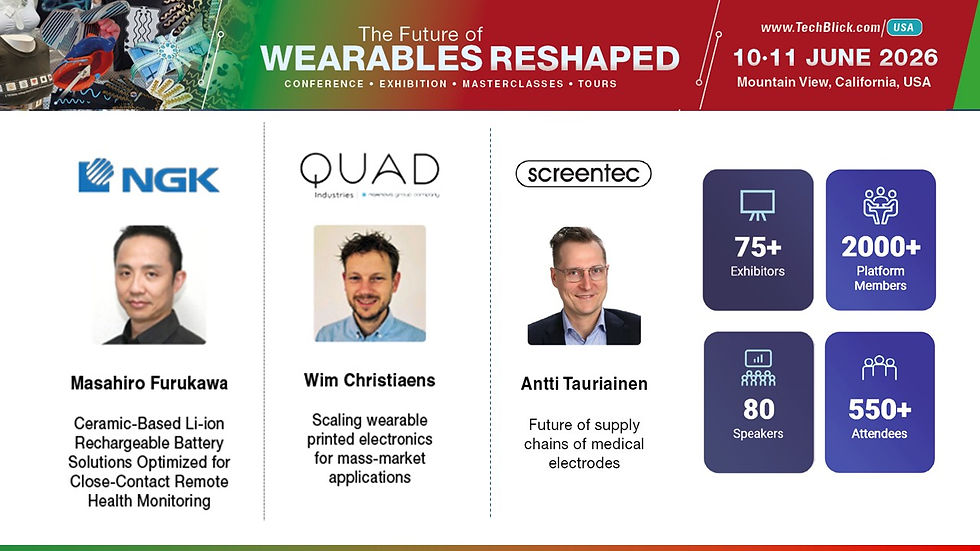
NGK Insulators LTD – Masahiro Furukawa introduces ceramic-based Li-ion rechargeable batteries for health monitoring. Masahiro explores the safety and form-factor constraints of organic-based batteries in close-contact wearable patches for preventive care. These ceramic-based batteries feature a semi-solid structure that is thin, bendable, and exceptionally safe for skin contact. This technology offers a multi-year storage solution with fast-charging capabilities, optimized for home disease management devices.
Quad Industries – Wim Christiaens discusses scaling wearable printed electronics for mass-market applications. Wim explores the technical gap between promising lab prototypes and the reliable, repeatable manufacturing required for large-scale commercial success. The presentation uses case studies to show how design choices and process development influence final production costs. This work offers an industrial perspective on moving wearable systems from the laboratory to cost-effective mass production.
Screentec – Antti Tauriainen discusses the future of supply chains for medical electrodes. Antti explores how shifting medical regulations and environmental requirements are creating instability in traditional material supply chains. The session covers approaches to design that account for technical, usability, and environmental requirements for disposable goods. This solution offers new strategies for manufacturing and supply chain management to ensure a steady supply of high-quality medical sensors.
🚨Explore the Full Agenda and Register before 3 May when early bird rates expire

University of North Carolina – Wubin Bai explores a multi-modal noninvasive in vivo biosensing system. Wubin explores the limitations of existing muscle tracking devices, which often rely on indirect surface measurements or specialized skin adhesion. This system utilizes near-infrared (NIR) light to capture muscular locomotion while an IMU decouples complex motion signals. This AI-boosted solution offers an adaptive model for classifying muscle activities, facilitating better diagnostics for neuromuscular disorders.
University of Southern California – Hangbo Zhao presents high-resolution liquid metal-based stretchable electronics. Hangbo explores the difficulty of achieving scalable, high-resolution patterning for liquid metal circuits used in cardiac mapping and soft robotics. By integrating colloidal self-assembly and micro-transfer printing, feature sizes as small as 5 µm are achieved. This work offers a method for creating microelectrode arrays that maintain high performance even under 1200% strain.
Yamagata University – Shizuo Tokito highlights flexible printed sensors for robotic hands. Shizuo explores the lack of human-like tactile sensing in current robotics, which prevents machines from handling fragile objects with precision. The talk details the use of porous piezoresistive layers and piezoelectric polymer inks printed on flexible substrates to emulate human skin. This work offers a lightweight, conformable sensing system that allows robotic hands to detect pressure, texture, and temperature.
🚨Explore the Full Agenda and Register before 3 May when early bird rates expire
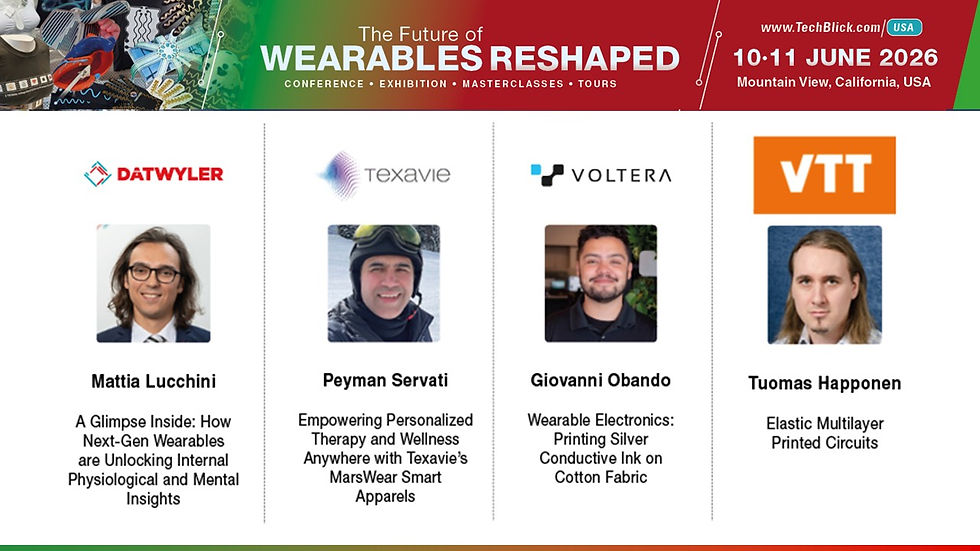
Datwyler Switzerland Inc. – Mattia Lucchini discusses unlocking internal physiological and mental insights via next-gen wearables. Mattia explores how current wearables focus almost exclusively on external behavior and activity levels, missing deeper contextual health data. The session reviews advancements in functional materials that enable the continuous collection of EEG and EMG biosignals. This solution offers a transformative opportunity for objective assessments of a user's mental and physiological status through sensor fusion.
Texavie – Peyman Servati explores MarsWear smart apparel for personalized therapy. Peyman explores the discomfort and lack of accuracy in traditional wearable devices used for long-term health monitoring and clinical assessment. MarsWear integrates yarn sensor technologies and machine learning into comfortable apparel to provide real-time feedback with high fidelity. This platform technology offers a groundbreaking solution for personalized wellness, gaming, and AR/VR control.
VTT – Tuomas Happonen highlights elastic multilayer printed circuits (EMPC). Tuomas explores the challenges of manufacturing sensitive, interference-tolerant elastic circuits using traditional rigid PCB methods. The approach uses stacked, pre-perforated TPU films with screen-printed filled vias to create robust multilayer architectures. This work offers an industrially feasible sheet-based process for creating complex, flexible circuits suitable for wearable RF applications.
Voltera – Giovanni Obando and East West Manufacturing conclude with mass-producing wearable biosensors. The sessions explore the specific challenges of printing silver conductive inks directly onto cotton fabrics and scaling these biosensors for volume production. By validating optimal print settings for textiles, these works move the industry closer to truly integrated "smart clothing." These combined solutions offer a pathway to mass-producing reliable, fabric-based heaters and biosensors for consumer and medical markets.
🚨 Explore the Full Agenda and Register before 3 May when early bird rates expire
Comments