


Printed Electronics: From Feasibility to Financial Reality
Author: Jurgen Westerhoff | jurgen.westerhoff@spgprints.com
Why printed electronics projects succeed or fail at the business case stage
Printed electronics has moved well beyond the experimental phase. Applications such as RFID antennas, in-mould heaters, biosensors, and energy components are increasingly transitioning into industrial-scale production. The technical promise is clear: lightweight designs, scalable manufacturing, and new functional integration possibilities. Yet many projects stall at a critical point — not because the technology fails, but because the business case remains unclear.
In most development trajectories, technical feasibility comes first. Teams focus on whether the application works: signal performance, resistance levels, feature resolution, and material compatibility. These are essential steps. Without them, there is no viable product.
However, technical validation alone does not justify investment.
A recurring issue in printed electronics projects is that financial validation happens too late. Organizations often confirm that a product works before asking whether it can be produced profitably, reliably, and at scale. This creates a structural risk. By the time cost models, yield assumptions, and capital requirements are analysed, significant time and resources have already been committed.
We are exhibiting at
The Future of Electronics RESHAPED
in California, USA on 10-11 June 2026.
Please register to meet us in person and see our technology in action.
Two dimensions that define a viable business case
1. Product economics
At scale, small process variations translate into significant financial impact. Key variables include:
Cost per unit of output
Yield and repeatability at production speed
Sensitivity to raw material costs such as silver volatility
Competitive positioning against alternative production technologies
In high-volume applications such as antennas, material consumption alone can determine profitability. Even marginal improvements in ink deposition or yield can shift the economics substantially.
2. Capital investment
Beyond unit economics, investment decisions depend on:
Required CapEx and installation timeline
Total Cost of Ownership (TCO)
Expected return on investment (ROI)
Alignment with growth strategy
A common pitfall is improving individual components without considering system-level performance. Printed electronics production is an interdependent system where throughput, yield, material usage, and uptime are tightly linked. Business cases fail when this system perspective is missing.
We are presenting at
The Future of Electronics RESHAPED
in California, USA on 10-11 June 2026.
Please register to meet us in person and listen to our presentation.
As production scales, consistency becomes more important than peak performance. The key question becomes: can it work continuously, predictably, and within defined cost limits? Achieving this requires alignment between equipment, process parameters, and application requirements. To help with this analysis SPGPrints made an ROI calculator to find out the financial differences between flatbed and rotary screen printing: Printed Electronics ROI Calculation Tool

The role of an integrated technology partner
For many organisations, bridging the gap between feasibility and a robust business case requires more than in-house engineering. It requires a partner that understands both process performance and production economics. SPGPrints approaches printed electronics from a system perspective, combining rotary screen printing technology, screen manufacturing, and application expertise. This integrated approach reduces variability between process steps and enables more predictable outcomes at production scale.
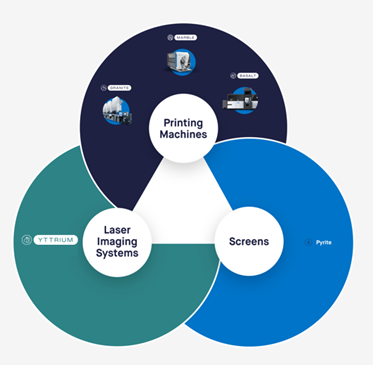
Rather than focusing on individual components, the emphasis is on line-level performance: consistent ink deposition, controlled feature definition, and repeatable results at industrial speeds. These factors directly influence yield, material efficiency, and ultimately cost per unit.
In parallel, application specialists support the translation of technical parameters into economic models. By linking process settings to cost drivers such as silver consumption, uptime, and scrap rates, organisations can build more accurate and defensible business cases.
Successful projects bring technical and financial evaluation together from the start. Instead of sequential decision-making, they model cost-per-output alongside feasibility testing, validate yield under realistic conditions, and assess sensitivity to process variation. This reduces the risk of late-stage surprises and strengthens internal decision-making.
Conclusion: Treat the business case as a design parameter
Printed electronics projects do not fail due to lack of innovation. They fail when economic validation lags behind technical progress. By integrating financial analysis early, focusing on system-level performance and working with partners who understand both technology and production conomics, organisations can move beyond feasibility and build a credible path to scale.
The key shift is simple: treat the business case not as a final checkpoint, but as a core design parameter from the outset.
Join the flagship TechBlick events in California on 10-11 June 2026, and in Berlin on 21-22 October 2026
This event is the global home of the Additive, Printed, Sustainable, Hybrid and 3D Electronics. It is where the global industry connects, where the latest is unveiled and where big products, novel ideas and key projects and partnerships are discussed and forged. This event is not to be missed!
This year, the California event will also feature.


This year, the Berlin event will also feature:

Comments