


Recent Silver-Plated Copper Inks Developments | Henkel Adhesive Technologies
Author: Thibaut Soulestin, PhD; Technology Manager Printed Electronics; Henkel Adhesive Technologies; thibaut.soulestin@henkel.com
Henkel Adhesive Technologies holds leading market positions worldwide in the industrial and consumer business. As a global leader in adhesives, sealants, and functional coatings, Henkel has developed a broad portfolio of LOCTITE® conductive inks and coatings. The LOCTITE® Printed Electronics portfolio includes more than 100 material solutions. Henkel silver inks are recognized for their reliability, printability, and ease of processing.
This article examines silver-plated copper (SPC) inks as a lower cost and more price-stable alternative to conventional silver inks. It explains importance of raw material selection and formulation behind reliable electrical conductivity; and presents processing, aging, and compatibility data for LOCTITE® ECI 4010.

We are exhibiting at
The Future of Electronics RESHAPED
Please register to meet us in person and see our technology in action.

Economical Context
Silver price fluctuations directly affect the cost of conventional silver-based electrically conductive inks. Over the past 20 years, silver has shown large and rapid price variations, as shown in Figure 1. A first peak occurred in 2011-2012, close to 50 USD/tOz. Earlier this year, silver reached record prices above 100 USD/tOz. Prices have since decreased, but have not returned below 30 USD/tOz. Silver demand remains supported by a sixth consecutive year of market deficit, and a return to low prices is not expected. Silver-plated copper (SPC) fillers reduce the exposure to these fluctuations because copper replaces most of the silver, while the silver shell protects the conductive surface.

SPC flakes are not necessarily less expensive than pure silver flakes. Copper preparation and silver plating add manufacturing steps. SPC becomes economically attractive only when the reduction in silver content offsets this additional processing cost. LOCTITE® ECI 4010 contains less than 20 wt% silver and is therefore substantially less sensitive to silver-price fluctuations than conventional silver inks.
The Importance of the Conductive Path
2.1 Electrical Contact
An ink is electrically conductive only if its particles form a continuous network through direct surface contact. Metal purity alone is insufficient. Particle shape, size distribution, surface condition, packing, loading, binder content, and drying/curing determine the number and quality of these conductive contacts.
Oxides, organic residues, dispersants, and binder films can remain between adjacent particles and increase contact resistance negatively affecting overall performance.
Not all silver particles are suitable for electrically conductive inks, and the same applies to silver-plated copper particles. Selecting the right conductive filler and combining it with the right formulation to meet customer requirements is where the know-how of Henkel chemists lies.
We are presenting at
The Future of Electronics RESHAPED
Please register to meet us in person and listen to our presentation.

2.2 Sintering
Sintering creates direct metal-to-metal necks between particles. It reduces interfacial resistance and brings the coating closer to bulk-metal behavior. It requires additional processing such as temperatures significantly above standard drying temperatures, high-energy radiation, inert or reducing atmosphere. It is particularly important for copper, because copper oxide is poorly conductive and forms an insulating layer around the particles. The trade-off is mechanical: a strongly sintered network is generally stiffer and cannot provide the flexibility or elongation of polymer-bound flake ink. The optimum conduction mechanism therefore depends on the application. Sintered systems favor conductivity, whereas polymer-bound flake systems provide a better balance of conductivity, adhesion, and flexibility.
2.3 Focus on Silver-Plated Copper Inks
Not all SPC flakes are equivalent. Particle morphology, size distribution, copper-surface preparation, and silver-shell uniformity control conductivity and environmental stability. A continuous silver layer is required to protect the copper core and provide a stable conductive surface. Thanks to this silver layer, sintering is not required to maintain electrically conductive particle-particle interfaces. Standard hot-air drying is sufficient, which simplifies processing and preserves the flexibility of the dried film.
Henkel screened several flake suppliers and has worked with a selected supplier since 2014 to optimize the particle technology. However, the flake is only one part of the system. Formulation and manufacturing must preserve the silver shell and produce reliable inks.
The main degradation mechanism and reliability risk is chemical. Chemicals that dissolve or mobilize silver can expose copper, accelerate oxidation, and increase resistance. For example, hydrogels can be especially aggressive. Adjacent inks, pressure-sensitive adhesives, and encapsulants must also be validated in the complete material stack.
Henkel evaluated hundreds of formulations before selecting the particle, binder system, and manufacturing process used for LOCTITE® ECI 4010.
LOCTITE® ECI 4010
3.1 Typical Properties
LOCTITE® ECI 4010 is a thermoplastic, screen-printable SPC ink developed for flexible conductive circuits. Its principal properties are summarized in Table 1.

The product combines a typical sheet resistance of 0.025 Ω/sq/25 µm with 5B adhesion on PET and PI. Its silver content below 20 wt% limits exposure to silver-price fluctuations, while keeping processing similar to that of conventional silver inks. Recommended processing conditions are given in Table 2.

The ink is ready to use for flatbed screen-printing. DBE-9 may be added in small increments, up to 10 wt%, to adjust viscosity for rotary screen printing. Dilution can improve transfer but may affect overall performance; the complete process must therefore be reoptimized after dilution.
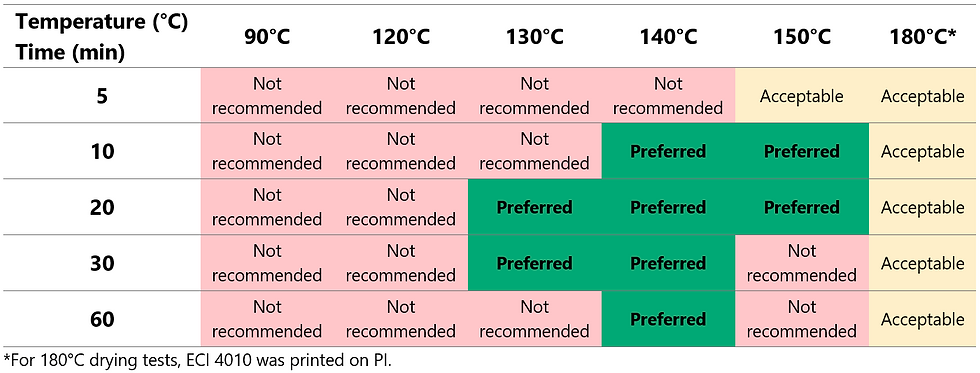
Table 3 summarizes the tested drying window. Sheet resistance may already appear acceptable, while insufficient time or temperature leaves adhesion, cohesion, or double-crease performance below target. The recommended conditions are 140-150°C in a conveyor oven for a few minutes, the time being adjusted to the oven dimensions and efficiency.
The ink showed good adhesion on PET, PI, copper, aluminum, and glass after appropriate drying. The main solvent can induce stress cracking in PC. ECI 4010 is not intended for stretchable substrates such as TPU.
3.2 Accelerated Aging Tests of Bare Ink
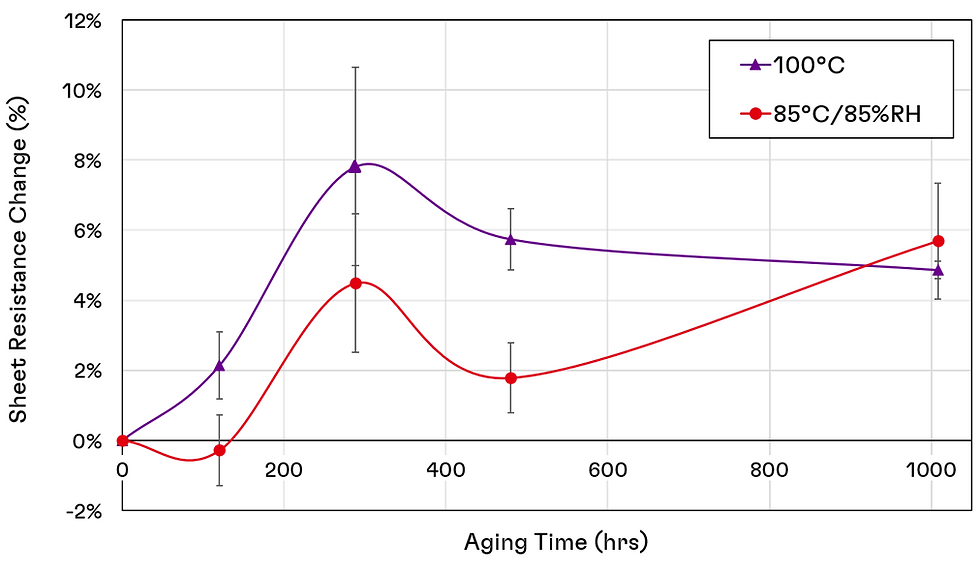
ECI 4010 was printed on 125 µm untreated PET through a 77/55 polyester screen and dried for 10 minutes at 150 °C in a box oven. Bare tracks were aged for up to 1000 hours under two conditions:
100 °C dry heat;
85 °C/85% relative humidity.
Figure 2 shows the evolution of sheet resistance during aging. The change remained below 10% after 1000 hours under both conditions. Adhesion remained rated 5B, with no cohesive failure observed, according to ASTM D3359.
After double-crease tests, the tracks remained intact, with no visible cracking. The post-crease resistance increase stayed in the 40–60% range for all aging times and conditions.
These results show that a properly processed SPC ink can retain electrical and mechanical performance under prolonged thermal and humid aging.
3.3 Compatibility with Dielectric and Carbon Inks
SPC inks must be evaluated with every material printed above or adjacent to the conductor. A chemically incompatible dielectric, carbon ink, or adhesive can damage the silver shell and expose copper.
A carbon or dielectric ink is considered compatible, when it does not induce a continuous drift with increasing aging time of typical properties like sheet resistance, adhesion, and flexibility.
LOCTITE® EDAG 456 is the preferred dielectric for use with ECI 4010. LOCTITE® EDAG 452SS and LOCTITE® EDAG PF 455B were not compatible under the full accelerated-aging test conditions.
Among the carbon inks evaluated, LOCTITE® EDAG PF 407A and LOCTITE® EDAG 965SS were compatible. LOCTITE® EDAG 965SS is particularly suitable for over-track protection in tail-connector areas. LOCTITE® EDAG 440A was not compatible.

3.4 Product Carbon Footprint
In 2025, the Henkel silver ink range already used 53 wt% recycled silver. Using flakes made from recycled silver reduces the product carbon footprint, PCF, by about 80% compared with an ink based on mined silver.
Replacing part of the silver with copper further reduces the quantity of recycled silver required per kilogram of ink.
PCF data are available per ink on customer request.
Typical Applications
LOCTITE® ECI 4010 is designed for applications in which price stability, processability, and reliability matter more than maximum electrical conductivity or stretchability.
Human-machine interfaces (HMI) are a primary use case. Membrane switches, keypads, control panels, and capacitive touch sensors generally do not require the conductivity of a highly conductive or sintered silver ink.
Printed heaters are a second use case. ECI 4010 can act as the heating meander track for a fixed power heater up to 100°C. It can also be used as busbars, thanks to its compatibility with carbon inks, in low power heaters. When high current densities are required, highly electrically conductive silver inks like LOCTITE® ECI 1010 or LOCTITE® ECI 1011 are more cost-efficient., because their lower sheet resistance allows thinner or narrower tracks at the same track resistance.
ECI 4010 is also suitable for antennas in cost-driven designs, typically NFC or UHF RFID, on PET or paper substrates. Its excellent adhesion to aluminum and copper broadens the application scope and allows combination with etched foils, bridges, jumpers, or connection pads. For GHz applications or large-area antennas, ECI 1011 is preferred. Its very low sheet resistance and low surface roughness allow very thin printed layers, which is often also the more cost-efficient solution.
Figure 3. Examples of typical applications using LOCTITE® ECI 4010
ECI 4010 is not recommended for medical electrodes as the hydrogel will dissolve the protective silver shell around the copper flakes.
Conclusion
SPC inks provide a practical route to reduce silver content and limit sensitivity to silver-price fluctuations.
LOCTITE® ECI 4010 combines less than 20 wt% silver with conventional screen-printing processability, a typical sheet resistance of 0.025 Ω/sq/25 µm, 5B adhesion on PET and PI, and less than 10% resistance change after 1000 hours at 100 °C or 85 °C/85% relative humidity. It is compatible with selected dielectric and carbon inks and is well suited to human-machine interfaces, membrane switches, capacitive sensors, and selected heater and antenna designs.
By reducing primary silver demand and incorporating recycled silver, LOCTITE® ECI 4010 also offers a route toward a lower and more stable material footprint. Final environmental performance must nevertheless be assessed at product and application level.
SPC inks are not intrinsically unstable. Similarly to silver inks, their reliability depends on flake quality, formulation, processing and compatibility with adjacent materials. Chemicals that dissolve or mobilize silver may expose copper and degrade conductivity; application-specific validation remains essential. Based on Henkel’s development work and available information, we have no evidence that the silver coating of properly manufactured SPC flakes spontaneously peels or delaminates during ink storage, printing, or normal service.
Join Us in Berlin This year, the event will also feature:
Electronic Textiles RESHAPED All included in your pass!
The discussion on silver-plated copper inks was really interesting, especially the focus on conductivity and material stability. For some downtime, I’ve also been playing Stickman Hook and it’s a simple, fun way to relax for a few minutes.