


Speaker Lineup and Agenda: The Future of Electronics RESHAPED USA 2026
Future of Electronics RESHAPED: USA conference arrives in Mountain View, California, on 10-11 June 2026. Held at the Computer History Museum, this global gathering focuses on the commercialization and technical advancement of additive, printed, 3D, and wearable electronics. This is the most important and the largest conference and exhibition of the year dedicated to printed electronics, additive electronics, 3D electronics, wearable electronics, flexible electronics and hybrid electronics.
The 2026 agenda features deep-tech presentations from industry leaders covering material innovations, scalable roll-to-roll (R2R) manufacturing, and novel hardware applications.
Final early bird rates expire on 30 May. Register Now!

High-precision capillary printing, roll-to-roll VIA printing, and electrochemical additive manufacturing (ECAM) for thermal management.
Sub-Micron Printing, Scalable FHE, and Next-Gen AI Cooling? Here we introduce the talks to be given in Mountain View at Day 1, Track 1, Keynote Presentations covering high-precision capillary printing, roll-to-roll VIA printing, and electrochemical additive manufacturing (ECAM) for thermal management.
Hummink | Pascal Boncenne Topic: HPCaP (High Precision Capillary Printing) : A Technology for Advanced Packaging. Pascal explores the strict micron-scale limitations of traditional inkjet printing, which relies on external lasers, pressure, or UV energy and struggles with high-viscosity materials. The presentation reveals High Precision Capillary Printing (HPCaP), an AFM-inspired glass micropipette mechanism that leverages natural capillary forces and controlled resonance to deposit polymers and conductive inks down to 100 nanometers. This solution delivers a sustainable, sub-micron patterning alternative tailored for semiconductor packaging, display repair, and biosensors.
TracXon | Thomas Kolbush Topic: Scaling Roll-to-Roll Flexible Hybrid Electronics: From Patented VIA Fabrication to Mainstream Manufacturing. The session explores the heavy infrastructure and resource-intensive constraints of decades-old subtractive PCB technology, which cannot sustainably scale to meet the demand for hundreds of billions of new IoT devices. The talk unveils the industry’s first commercial roll-to-roll VIA printer, an additive technology capable of manufacturing double-sided circuitry on flexible substrates 10x faster than traditional lines. This patented equipment provides a high-throughput, responsible blueprint that slashes CO₂ emissions by 5x and material consumption by 10x.
Fabric8Labs | Michael Matthews Topic: Reshaping Thermal Management: How ECAM Unlocks Next-Gen Cooling for AI & High-Performance Computing. Michael explores how traditional skiving and powder-based 3D printing fail to manufacture the complex, high-resolution geometries required to cool AI accelerators pushing power densities beyond 4 W/mm². The talk introduces Electrochemical Additive Manufacturing (ECAM), which uses a micro-electrode array to deposit pure copper atom-by-atom at room temperature without thermal stress. This technology delivers a 90% lower greenhouse gas footprint while providing optimized cold plates that achieve an 8.2°C reduction in maximum temperature for data center cooling.

Wearables in pharma, sustainable FHE manufacturing, internal physiological insight tracking, and body-integrated medical sensors.
Next-Gen Wearable Electronics & Invisible Monitoring? Here we introduce the talks to be given in Mountain View at Day 1, Track 1, Session 2 covering wearables in pharma, sustainable FHE manufacturing, internal physiological insight tracking, and body-integrated medical sensors.
Genentech (Roche Group) | Paul Upham Topic: Wearables in Pharma. Paul explores how traditional pharmaceutical development often lacks continuous, real-world data from the patient's home environment to establish stronger clinical endpoints. The talk highlights how integrating wearable technologies across multiple disease domains captures high-utility patient data. This work offers a powerful framework for utilizing wearables to improve clinical trial accuracy and accelerate drug development.
GE Healthcare | Gurvinder Topic: Sustainability-to-Scalability in FHE: Screening LCA Insights and AI/ML-Enabled Manufacturing. Gurvinder explores the high environmental impacts and slow qualification cycles that limit the scale-up of conventional flex circuitry. The presentation reveals a life cycle assessment (LCA) proving printed flex reduces fabrication impacts by up to 80%, paired with an AI/ML workflow for in-line defect detection. This solution provides an optimized, low-emission roadmap for mass-producing vital sign monitoring patches.
Datwyler Switzerland Inc. | Mattia Lucchini Topic: A Glimpse Inside: How Next-Gen Wearables are Unlocking Internal Physiological and Mental Insights. Mattia explores the current limitation of wearable devices, which have historically focused on superficial, external behavioral tracking rather than deeper internal states. The talk demonstrates how breakthrough functional materials and advanced sensor fusion unlock continuous access to complex biosignals like EEG and EMG. This work offers a transformative method for objectively assessing a user's true mental and physiological status unobtrusively.
Linxens Heealthcare | Bryce Hinkson Topic: From Invasive to Invisible, How Wearable Technologies Transform Our Practices. Bryce explores the patient burden and clinical limitations associated with invasive, episodic healthcare monitoring solutions. The session outlines how advancements in flexible electronics and skin-contact sensors enable continuous, "invisible" physiological tracking without compromising medical accuracy or regulatory compliance. This solution provides healthcare providers and medtech innovators with a scalable pathway toward truly patient-centric care.

The Future of Electronics RESHAPED: High-resolution 3D printing, advanced in-situ material annealing, and microgravity electronics manufacturing.
High-Resolution 3D Printing & Space-Based Manufacturing of Electronics? Here we introduce the talks to be given in Mountain View at Day 1, Track 1, Session 3 covering high-resolution 3D printing, advanced in-situ material annealing, and microgravity electronics manufacturing.
Holst Centre | Hylke Akkerman Topic: 3D Microelectronics Without Limits: High Resolution Printing for the Next Generation of Integration. Hylke explores how planar manufacturing constraints limit the transition to fully spatial, ultra-miniaturized electronic systems. The presentation details foil laminated stereolithography (f-SLA), which combines high-resolution UV structuring with vertical interconnects formed directly during printing. This work offers a highly sustainable, short-lead-time platform for embedded bare die integration at a 10–20 µm scale.
Rice University | Yong Lin Kong Topic: Near-field microwave 3D printing of electronics. Yong explores a fundamental limitation in electronic 3D printing where the inability to selectively anneal materials destroys temperature-sensitive substrates. The talk reveals how focusing microwaves using a metamaterial-inspired near-field electromagnetic structure (Meta-NFS) achieves rapid, highly selective volumetric heating in situ. This solution provides a method to locally program electronic properties, broadening the material palettes compatible with 3D printing.
Notion Systems | Simon Rihm Topic: From Subtractive to Additive: Shaping the Future of R&D with the new n.jet evo. Simon explores the complex manufacturing challenges that arise when trying to replace traditional subtractive process chains with additive steps. The session demonstrates how the n.jet evo desktop inkjet system allows R&D labs to evaluate new processes, functional inks, and substrates under industrial standards. This work offers a simple, efficient bridge to push additive manufacturing from lab concepts to industrial scale.
NASA Marshall Space Flight Center | Cadre Francis Topic: In-Space Manufacturing of Electronics. Cadre explores the logistical risks of long-duration space missions that rely entirely on earth-supplied electronics rather than autonomous, on-demand fabrication. The presentation evaluates how material formulation and deposition behave in microgravity environments without gravity-assisted flow. This solution provides critical insights into establishing real-time print stabilization, enhancing the resilience of future space exploration architectures.

Multi-layer R2R mass production, high-resolution flexographic printing, and sustainable rotary screen printing for RFID.
Roll-to-Roll (R2R) Mass Production of Printed Electronics? Here we introduce the talks to be given in Mountain View at Day 1, Track 1, Session 3 covering multi-layer R2R mass production, high-resolution flexographic printing, and sustainable rotary screen printing for RFID.
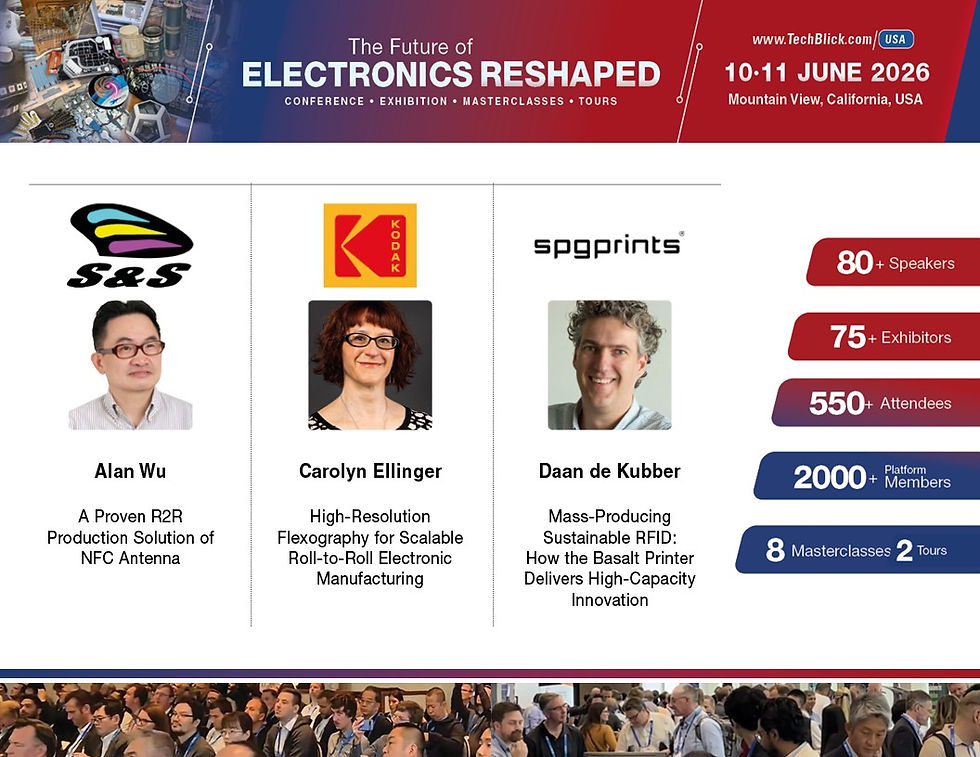
Smooth & Sharp Corporation | Alan Wu Topic: A Proven R2R Production Solution of NFC Antenna. Alan explores the complexity barriers that usually prevent additive manufacturing from moving beyond single-layer UHF antennas to sophisticated electronic functions. The talk reveals successful large-scale mass production techniques for multi-layer RFID/NFC circuits. This work offers proof that complicated circuit designs are now possible at scale using additive R2R processes.
Eastman Kodak Company | Carolyn Ellinger Topic: Flexography for High-Resolution Roll-to-Roll Manufacturing. Carolyn explores the boundaries of expanding volume production for high-resolution designs using traditional screen printing, which currently dominates printed electronics. The presentation provides an overview of how transitioning to roll-to-roll flexography can optimize the mass fabrication of highly replicated circuitry. This work offers a strategic analysis of the precise benefits and operational challenges of adopting flexo lines for high-volume manufacturing.
SPG Prints | Daan Dekubber Topic: Mass-Producing Sustainable RFID: How the Basalt Printer Delivers High-Capacity Innovation. Daan explores the heavy material waste and high environmental costs associated with traditional aluminum-etched RFID manufacturing. The session introduces a roll-to-roll rotary screen printing process utilizing paper substrates and graphite-based conductive inks to cut production costs by up to 25%. This solution provides an affordable, highly scalable, and completely aluminum-free pathway for mass-producing eco-friendly tags.
Stretchable low-temperature Ag inks, micro-transfer printing of liquid metal, liquid metal elastomer thermal interfaces, and silver MOD inks.
High-Performance Inks & Stretchable Electronic Materials? Here we introduce the talks to be given in Mountain View at Day 1, Track 2, Session 2 covering stretchable low-temperature Ag inks, micro-transfer printing of liquid metal, liquid metal elastomer thermal interfaces, and silver MOD inks.
Heraeus Electronics | Sai Vijayaraghavan Topic: Ag Inks for Stretchable Electronics. Sai explores the critical design and processing trade-offs required to ensure low-temperature silver inks maintain robust and reliable performance under mechanical deformation. The presentation evaluates how material selection and cure parameters directly influence electromechanical properties. This work offers a validated framework for optimizing ink performance in next-generation stretchable devices.
University of Southern California | Hangbo Zhao Topic: High-Resolution Liquid Metal-Based Stretchable Electronics Enabled By Colloidal Self-Assembly and Micro-Transfer Printing. Hangbo explores the manufacturing limitations that prevent liquid metal-based electronics from achieving scalable, high-resolution patterning below traditional macro-scales. The talk reveals an integrated method combining colloidal self-assembly and micro-transfer printing to achieve liquid metal particle features as small as 5 µm. This solution provides ultra-stretchable, low-impedance microelectrode arrays capable of high-resolution cardiac mapping under extreme deformations.
Arieca Inc | Navid Kazem Topic: Liquid Metal Embedded Elastomer Composites for Thermal Management of Next Generation High Performance Computing. Navid explores the extreme thermal and warpage challenges in AI semiconductor packaging where power densities are outstripping conventional thermal interface materials. The presentation demonstrates how translating liquid metal embedded elastomer (LMEE) technology into packaging provides a unique combination of high thermal dissipation and soft mechanical compliance. This work offers a reliable material architecture to reduce power consumption in next-generation high-performance computing centers.
Electroninks | Mitchell Smith Topic: Silver MOD Inks: Advancing Performance Beyond Particle Pastes. Mitchell explores the cost vulnerabilities and performance limits of traditional silver particle-based pastes facing volatile market pricing and high curing temperature requirements. The session breaks down the chemical mechanisms of metal organic decomposition (MOD) inks, which form denser conductive films using significantly less metal. This solution provides a lower-temperature curing pathway that opens high-performance conductive circuits to temperature-sensitive plastic substrates.

Embodied AI, intelligent cardiac monitoring, elastic multilayer printed circuits, and flexible ceramic battery solutions.
Data, AI, and Advanced Materials for Next-Gen Wearables? Here we introduce the talks to be given in Mountain View at Day 1, Track 2, Session 3 covering embodied AI, intelligent cardiac monitoring, elastic multilayer printed circuits, and flexible ceramic battery solutions.
Stanford University | Angela McIntyre Topic: Wearables as Embodied AI. Angela explores how traditional wearable devices often operate as passive trackers rather than closed-loop, physical agents that interpret and anticipate human intent. The session outlines how merging advanced machine learning with physical biological feedback allows AI to become physically "embodied." This framework provides the foundational hardware-software loop necessary to anticipate human movement and seamlessly bridge real-world biological feedback with physical hardware.
Medtronic | Rohan Sonawane Topic: Data and AI in Cardiac Monitoring. Rohan explores the challenge of turning massive streams of continuous physiological data into timely, meaningful insights without overwhelming care teams with false alerts. The talk demonstrates how AI can interpret continuous cardiac data within context to highlight critical patient risks early. This solution provides an intelligent, proactive monitoring system that helps anticipate deterioration in heart failure care and guide personalized interventions outside the hospital.
VTT | Tuomas Happonen Topic: Elastic Multilayer Printed Circuits. Tuomas explores the difficulty of manufacturing sensitive, interference-tolerant elastic circuits that can withstand the physical requirements of mixed-signal and RF applications. The presentation details a sheet-based manufacturing method that stacks pre-perforated TPU films and cures screen-printed conductive circuits with filled vias layer by layer. This work offers a robust architecture for integrating surface-mounted devices onto highly flexible, multilayer laminates.
NGK Insulators LTD | Masahiro Furukawa Topic: Ceramic-Based Li-ion Rechargeable Battery Solutions Optimized for Close-Contact Remote Health Monitoring. Masahiro explores the need for ultra-safe, thin, and flexible battery solutions that can fit body contours without the safety risks of traditional organic components in skin-contact applications. The session introduces a semi-solid, ceramic-based Li-ion rechargeable battery featuring low self-discharge and high over-discharge resistance. This technology provides a highly reliable, fast-charging power source tailored for remote health monitoring patches and medical devices.

Yarn-sensor smart apparel, conductive silver ink printing on cotton, and mass-market scalability for wearables.
Smart Apparel, Textile Printing, and Scaled Production? Here we introduce the talks to be given in Mountain View at Day 1, Track 2, Session 4 covering yarn-sensor smart apparel, conductive silver ink printing on cotton, and mass-market scalability for wearables.
Texavie | Peyman Servati Topic: Empowering Personalized Therapy and Wellness Anywhere with Texavie’s MarsWear Smart Apparels. Peyman explores the difficulty of developing comfortable, everyday wearable therapeutics that provide clinicians with highly accurate, objective biometric data. The talk introduces a smart textile platform using advanced yarn sensor technologies and machine learning, alongside integrated patented solar fabrics for green energy harvesting. This solution provides an intelligent, highly versatile system for personalized therapy, gaming, and AR/VR control.
Voltera | Giovanni Obando Topic: Wearable Electronics: Printing Silver Conductive Ink on Cotton Fabric. Giovanni explores the processing challenges and setting parameters required to print highly functional conductive inks directly onto rough, absorbent textiles like cotton without losing performance. The presentation evaluates the direct application of silver conductive inks to construct fully functioning heating elements. This work offers a validated manufacturing methodology for creating direct-to-fabric consumer products like heated medical and outdoor apparel.
Quad Industries | Wim Christiaens Topic: Scaling wearable printed electronics for mass-market applications. Wim explores the technical bottleneck where high-functioning laboratory wearable prototypes consistently fail to achieve reliable, repeatable replication during mass industrial fabrication. The session analyzes real-world case studies to demonstrate how critical design choices and material selections impact the cost-effective production floor. This work provides an optimized framework for successfully scaling printed electronics into mass-market commercial applications.

Sustainable board-level additive manufacturing, printed embedded resistors, 3D MEMS IMU additive packaging, and programmable cloud-native PLM software.
Additive Packaging, Printed Passives, and Next-Gen PLM Systems? Here we introduce the talks to be given in Mountain View at Day 1, Track 3, Session 2 covering sustainable board-level additive manufacturing, printed embedded resistors, 3D MEMS IMU additive packaging, and programmable cloud-native PLM software.
Raytheon | An RTX Business | Daniel Hines Topic: Hybrid Electronics for Environmentally Sustainable Board Level, Additive Manufacturing of Passive Components. Daniel explores the strict size, weight, and power (SWaP) demands alongside traditional PCB material waste challenges that limit eco-friendly domestic electronics manufacturing. The presentation highlights hybrid electronics (HE) design methods used to print passive insulator materials for solder masks and replace bulky, heavy, manually tuned RF filters. This work offers a highly sustainable manufacturing alternative that enables tight, eco-friendly integration of digital and RF circuit card assemblies.
UMass Lowell | Guinevere Strack Topic: Printed Resistors for Low-Cost Sustainable, Semi-Additive PCBs. Guinevere explores how current state-of-the-art embedded resistor technologies rely on complex, energy-intensive subtractive processes that generate excessive hazardous waste. The talk outlines an additive manufacturing framework for printing thick-film resistors directly onto PCB substrates using resistive inks. This solution provides a low-cost, scalable pathway to eliminate surface-mounted component counts, reduce parasitics, and seamlessly integrate additive technologies into high-throughput production lines.
GE Aerospace Research | David Lin Topic: 3D MEMS IMU enabled by Additive Packaging. David explores how complex, rigid 3D assemblies of traditional MEMS inertial measurement units are highly vulnerable to package-induced stress and long-term thermal drift. The session reveals an innovative aluminum nitride (AlN) based additive packaging process that replaces multi-component frames with a single, compact, direct pick-and-place component. This technology provides an ultra-low SWaP-C IMU that yields a 3X improvement in thermally induced drift, optimized to survive harsh environmental navigation.
Altium & Duro | Justin Sears & Michael Corr Topic: When Your Electronics Bend, Your PLM Shouldn't Break. Justin and Michael explore how hardware engineering groups adopting flexible, hybrid, and stretchable form factors are constrained by legacy, rigid Product Lifecycle Management (PLM) architectures. The talk breaks down a modernized approach featuring cloud-native, AI-driven, and API-first architectures that treat product data as an automated, living, and queryable ecosystem. This framework offers electronic hardware teams the infrastructure to accelerate design iterations much like modern agile software teams.

Fine-line screen printing, conductive ink formulations, alternative metal paste equipment, and nano-surface mesh treatments.
Fine Line Screen Printing & Material Innovations? Here we introduce the talks to be given in Mountain View at Day 1, Track 3, Session 3 covering fine-line screen printing, conductive ink formulations, alternative metal paste equipment, and nano-surface mesh treatments.
Sefar | Mark Pintar Topic: Fine Line Screen Printed Electronics. Mark explores the critical operational gap between lab-scale possibilities and real-world floor practicality in modern screen printing workflows. The presentation breaks down practical manufacturing limits and demonstrates how to optimize current setup assets for high-precision jobs. This work provides attendees with a direct baseline to audit their current printing infrastructure for fine-feature readiness.
Nagase ChemteX | Brandon Peters Topic: Materials and Process Innovations in Fine Line Conductive Ink Printing. Brandon explores the complex synchronization needed between ink chemistry, screen engineering, and substrate properties to prevent line blurring at advanced micro-scales. The session reveals how careful adjustments to mesh counts, emulsion profiles, and substrate surface energies dramatically improve electrical performance and line definition. This solution delivers a robust roadmap for achieving highly repeatable ultra-fine feature resolution.
Conductive Technologies | Alicen Pittenger Topic: Process Improvements in Materials and Equipment for Printed Electronics. Alicen explores how raw silver market volatility and outdated equipment registration limit cost-sensitive, high-volume production lines. The talk highlights the adoption of alternative silver-carbon blends and copper inks paired with high-speed Sakurai optical registration press hardware. This combination provides a predictable framework to boost print precision, stabilize material costs, and scale production runs with confidence.
MicroScreen LLC | Art Dobie Topic: Effect of Hydrophobic/Oleophobic Nano Surface Treatment on the Release of Resistive PTC carbon paste from Emulsion Screens for Screen-Printed Heater Applications. Art explores the poor paste release and sticky screen-peel behavior that degrades print accuracy when using resistive PTC carbon pastes for printed heater elements. The presentation evaluates the transfer of successful stencil nano-coatings directly onto PVA-PVOH emulsion screen cavities to smooth the paste release dynamics. This empirical study delivers quantified deposition data to resolve transfer-efficiency issues in functional paste printing.

Silver-coated copper trace pastes, printed antenna processing, and full silver ink substitution with copper
High-Performance Copper Substitutes & Antenna Materials? Here we introduce the talks to be given in Mountain View at Day 1, Track 3, Session 4 covering silver-coated copper trace pastes, printed antenna processing, and full silver ink substitution with copper
Tatsuta | Robert Wilson Topic: Silver-Coated Copper Particle Circuit Trace Conductive Pastes. Robert explores how severe oxidation issues in fine copper particles compromise reliability, while pure silver inks remain too expensive for mass additive PCB/FPC workflows. The talk details an innovative silver-coated copper particle trace paste that reduces CO₂ emissions to 18% and liquid waste to 7% compared to subtractive chemical etching. This work offers an economically competitive, eco-friendly solution for high-volume manufacturing lines.
Henkel | Julie Ferrigno Topic: Materials & Processes for Printed Antennas. Julie explores the processing trade-offs required to maintain precise feature uniformities and low surface roughness for high-frequency RF antenna structures. The presentation evaluates the performance spectrum of high-conductivity silver inks, lower-cost silver-plated copper (SPC) alternatives, and high-throughput 3D pad printing methods. This work provides an optimized material selection framework for balancing production costs with strict RF performance metrics.
Copprint | Ofer Shochet Topic: Silver performance, copper price – the inevitable transition to copper. Ofer explores how massive demand surges from photovoltaics and EVs have turned raw silver into a punishing "silver tax" that heavily threatens the gross margins of printed electronics. The session challenges the long-term viability of silver-coated alternatives, presenting the technical and financial case for full copper ink substitution. This solution maps a realistic transition pathway to help manufacturers manage risk and shield their supply chains from raw material price volatility.

Additive high-temperature antennas, flexible mmWave copper antennas, laser-assisted ultra-high adhesion traces, and inkless dry-additive nanomanufacturing.
High-Temperature Antennas, Fine-Line Copper, and Inkless Nano-Printing? Here we introduce the talks to be given in Mountain View at Day 2, Track 1, Session 1 covering additive high-temperature antennas, flexible mmWave copper antennas, laser-assisted ultra-high adhesion traces, and inkless dry-additive nanomanufacturing.
Lockheed Martin | Paul Gaylo Topic: Enabling High Temperature Antennas with Additive Manufacturing. Paul explores how extreme heat environments present severe engineering challenges that cannot be resolved by high-temperature materials alone. The presentation outlines how traditional fabrication methods fall short in managing the tight dimensional tolerances, mechanical joints, and metal-ceramic integration required for these devices. This work demonstrates how advanced additive manufacturing provides a preferred path to production by embedding multi-material interfaces and precise microstructural control into complex, heat-resilient antenna geometries.
NoiseFigure Research | Manish Ojha Topic: High-Resolution Printed Copper Antennas for Flexible mm Wave Electronics. Manish explores the lack of flexible mmWave antennas capable of high resolution and high production speeds for 24 GHz applications. The talk presents screen printing with copper conductive inks on polyimide and alumina ribbon ceramics to achieve an exceptional 50 µm resolution at a speed of 10,000 sq mm/s. This work offers a proven method for integrating bare die chipsets with flexible antennas, showing strong agreement between simulation and measured performance.
Akoneer | Tadas Kildusis Topic: Creating high density and high adhesion Cu traces on any dielectric substrate. Tadas explores the difficulty of achieving high feature density alongside strong trace adhesion when trying to pattern copper across diverse, non-traditional dielectric substrates. The session introduces the SSAIL direct-write method, which utilizes ultrashort pulsed laser and chemical processing to plate electroless copper traces down to 1 µm. This technology provides excellent surface roughness and trace adhesion of 6–30 N/mm², optimized for high-power and high-frequency applications.
NanoPrintek | Masoud Mahjouri-Samani, PhD Topic: Beyond Inks: Physics-Driven, AI-Enabled Additive Nanomanufacturing for Standardized Electronics. Masoud explores how reliance on complex, proprietary chemical ink formulations limits process stability, certification, and long-term supply-chain independence. The talk unveils an inkless, dry-additive nanomanufacturing platform that generates pure solid nanoparticles on demand, transporting and laser-sintering them in real time without binders or solvents. This physics-driven approach integrates AI closed-loop optimization to establish a deterministic, qualification-ready manufacturing standard.

Extreme-temperature thermocouple inks, 3D carbon microheaters, pilot-scale graphene printing, and high-purity carbon nanotube AI hardware.
High-Temperature Materials & Advanced Carbon Nanomaterials? Here we introduce the talks to be given in Mountain View at Day 2, Track 2, Session 1 covering extreme-temperature thermocouple inks, 3D carbon microheaters, pilot-scale graphene printing, and high-purity carbon nanotube AI hardware.
Applied Nanotech Inc | Richard Fink Topic: Novel Ink Development, Characterization, and Tests for Extreme Environments. Richard explores the severe shortage of cost-effective printed electronics capable of surviving oxygen-rich environments above 800 °C. The presentation details the development of Chromel and Alumel inks for Type-K thermocouples, alongside molybdenum materials protected by an oxidation barrier for high-temperature ceramic antennas. This work demonstrates a predictable, linear frequency shift in air, providing a robust sensing framework for extreme thermal environments.
iGii (Integrated Graphene) | Michelle Ntola Topic: 3D Carbon Nanomaterials to Change the Landscape of Functional Materials. Michelle explores the supply-chain risks and high costs facing manufacturers heavily reliant on silver and traditional metal-heavy electrode formulations. The talk highlights Gii, a proprietary 3D carbon platform engineered as a metal-lean, drop-in alternative for roll-to-roll microheaters reaching 400 °C and high-reproducibility printed batteries. This solution provides a highly scalable, low-temperature fabrication method capable of producing millions of robust, cost-stable components annually.
Graphene Engineering Innovation Centre | Andrew Strudwick Topic: Graphene and 2D materials printed electronics. Andrew explores the technical gap between early laboratory excitement for 2D materials and the commercial scale-up required for practical industrial deployment. The session outlines how pilot-scale printing equipment and collaborative research frameworks accelerate the transition of graphene into next-generation products. This work provides an established engineering pathway for integrating 2D materials into environmental health sensors, flexible electronics, and energy-efficient heating elements.
NanoIntegris Technologies | Jefford Humes Topic: Beyond Silicon: High‑Purity Semiconducting Carbon Nanotubes as a Foundation for Next‑Generation AI Hardware. Jefford explores the physical and economic boundaries of conventional silicon, which currently constrain the energy efficiency needed for modern AI computing workloads. The talk reveals how high-purity semiconducting single-walled carbon nanotubes (s-SWCNTs) remove metallic degradation pathways to enable low-power, high-mobility field-effect transistors. This technology provides a printable, low-temperature fabrication standard for building reconfigurable edge devices, neuromorphic hardware, and energy-efficient in-memory computing systems.

Electroactive P(VDF-TrFE) coatings, capacitive keyboard production, printed trace PFAS detection sensors, and in-line R2R laser ablation patterning.
Functional Surfaces, Smart Interface Printing, and Real-Time Environmental Sensing? Here we introduce the talks to be given in Mountain View at Day 2, Track 3, Session 1 covering electroactive P(VDF-TrFE) coatings, capacitive keyboard production, printed trace PFAS detection sensors, and in-line R2R laser ablation patterning.
ALQIO | Fabien Resweber Topic: Empowering Scalable Innovation in Functional Surfaces. Fabien explores the challenge of transitioning flexible electroactive applications from experimental design to reliable, high-volume industrial processing. The presentation focuses on advanced formulation and coating capabilities utilizing piezoelectric P(VDF-TrFE) copolymers. This work offers a robust manufacturing pathway to integrate flexible haptic interfaces, heating surfaces, and medical instrumentation seamlessly into mass-market product architectures.
INO, d.o.o., Žiri | Matjaz Finzgar Topic: Printing Touch: Equipment and Process Perspectives on Capacitive Keyboard Production. Matjaz explores the critical process bottlenecks of capacitive keyboard manufacturing, where multi-layer registration errors and improper ink curing routinely threaten mechanical and electrical reliability. The talk outlines targeted equipment and process adjustments designed to maintain highly precise pattern geometries during scale-up. This solution provides a practical manufacturing blueprint to stabilize high equipment and material costs during the shift from prototyping to production.
Brewer Science | Shane Gumm Topic: Printed Electronics Solutions for Trace PFAS Detection and Measurement. Shane explores the major logistical bottleneck in environmental monitoring where dangerous, trace-level PFAS contaminants can only be identified via slow, expensive, centralized laboratory mass spectrometry. The session introduces a species-selective, low-cost printed sensor platform capable of executing rapid, real-time field testing. This advanced thin- and thick-film deposition technology delivers a decentralized monitoring model to empower utilities and communities with instant environmental data.
Intellivation LLC | Mark George Topic: R2R Platform for Deposition of Active and Passive Thin Films and Patterning for Flexible Electronic Sensors and Devices. Mark explores the high cost and labor-intensive constraints of using traditional mask lithography for patterning flexible active and passive thin films. The presentation demonstrates a high-throughput roll-to-roll sputtering platform paired with in-line laser ablation to pattern multilayers without causing sub-surface substrate degradation. This physics-driven solution combines digital laser annealing and subtractive patterning to manufacture fully functional flexible sensors rapidly and cost-effectively.

Solvent-free vapor jet printing, roll-to-roll printed OLED light films, and interactive organic electronic smart packaging.
Mask-less Deposition & Printed OLED Technologies? Here we introduce the talks to be given in Mountain View at Day 2, Track 1, Session 2 covering solvent-free vapor jet printing, roll-to-roll printed OLED light films, and interactive organic electronic smart packaging.
Universal Display Corporation | Mike Hack Topic: Universal Vapor Jet Printing (UVJP) - a Transformative Dry, solvent-free Printing and Deposition Technology. Mike explores the processing vulnerabilities of printing organic electronics via methods dependent on aggressive solvents and complex, multi-step lithography. The presentation unveils a digitally programmable, mask-less UVJP deposition platform that jets functional materials at low temperatures without any solvents. This technology provides a highly sustainable manufacturing alternative that protects solvent-sensitive substrates and unlocks previously unattainable device architectures.
Sinovia Technologies | Whitney Gaynor Topic: Roll-to-Roll Printed Light Film. Whitney explores how heavy reliance on expensive, ultra-high-vacuum deposition processes restricts organic light-emitting diodes (OLEDs) from achieving widespread, affordable commercial scale. The talk details the core fluid dynamics and layer uniformity principles required to successfully manufacture OLEDs via high-throughput flexographic printing lines. This work offers a strategic roadmap for using proprietary transparent conductive films to scale low-cost light films for Human-Machine Interface (HMI) applications.
Inuru | Speaker Marcin Ratajczak Topic: Seamless Integration of Printed OLEDs into Smart Packaging and Consumer Surfaces. The session explores how inkjet printing OLED lighting can create fully new use cases and applications.

FHE-enabled soft robotics, electrohydraulic artificial muscles, and multimodal printed tactile sensors.
Soft Robotics & Human-Like Tactile Sensing? Here we introduce the talks to be given in Mountain View at Day 2, Track 2, Session 3 covering FHE-enabled soft robotics, electrohydraulic artificial muscles, and multimodal printed tactile sensors.
GE Aerospace | Deepak Trivedi Topic: FHE Enabled Soft Robotics: Scaling Intelligence Beyond Compute. Deepak explores the scaling limitations of conventional robotics, which concentrate functions in rigid assemblies with centralized processing and suffer from exponential control burdens as degrees of freedom multiply. The presentation demonstrates an emerging paradigm where flexible electronics shift robots from assembled subsystems into unified functional materials with co-located sensing, actuation, and memristive neuromorphic computing. This work leverages materials science and electronic manufacturing to manage continuous deformation fields and enable edge-level feedback loops.
Artimus Robotics | Eric Acome Topic: From Rigid Motors to Flexible Artificial Muscles: The Development of Polymer-Based Electrohydraulic Actuators. Eric explores how physical AI is structurally limited by standard electric motors, which suffer from poor adaptability, high heat generation, and complex miniaturization. The talk details HASEL electrohydraulic actuators that utilize thin polymer films, flexible printed conductors, and liquid dielectrics to serve as true artificial muscles. This technology delivers direct linear motion and high power-to-weight ratios for dexterous robotic hands, wearables, and bio-inspired machinery.
Yamagata University | Shizuo Tokito Topic: Flexible Printed Sensors for Robotic Hands: Toward Human-Like Tactile Sensing. Shizuo explores the lack of lightweight, conformable tactile arrays needed to give humanoid robotic platforms human-like skin sensitivity and precise object manipulation. The session outlines a printing-based fabrication process using printed silver electrodes and porous, carbon-based piezoresistive and piezoelectric polymer inks. This advanced integration of materials science and flexible electronics enables robotic hands to detect subtle pressure, shear force, texture, and temperature for delicate object handling.

Dual-use hybrid validation frameworks, circular IoT hardware recycling, and viscous-jet drop-on-demand digital printing.
Manufacturing Readiness, Circular IoT, and High-Viscosity Jetting? Here we introduce the talks to be given in Mountain View at Day 2, Track 3, Session 2 covering dual-use hybrid validation frameworks, circular IoT hardware recycling, and viscous-jet drop-on-demand digital printing.
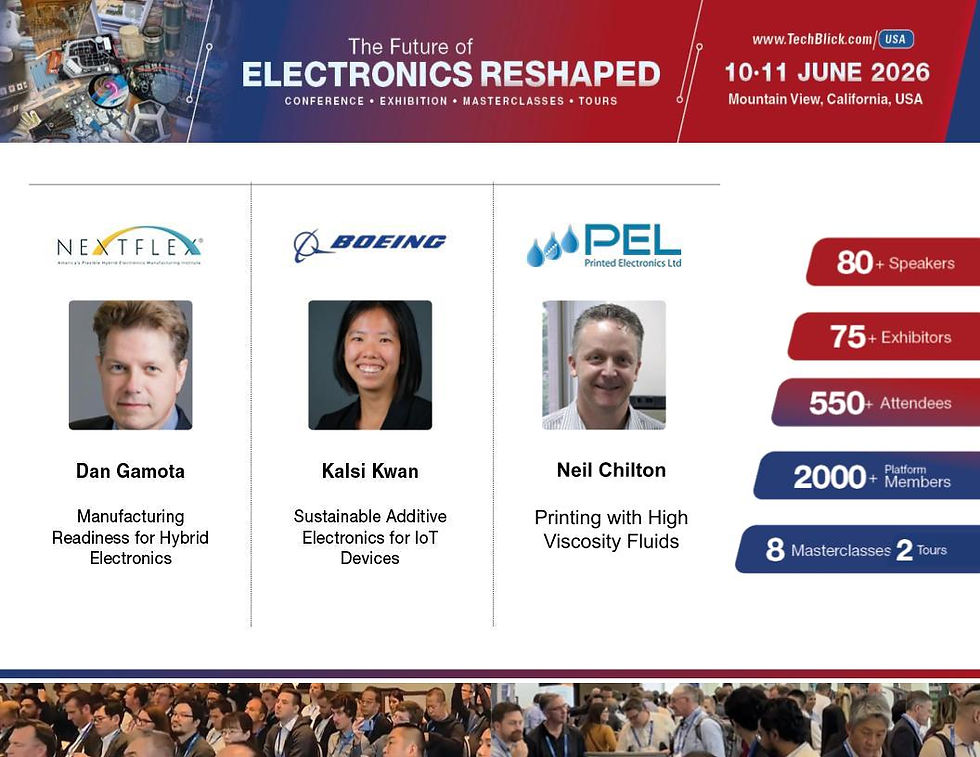
NextFlex | Dan Gamota Topic: Manufacturing Readiness for Hybrid Electronics. Dan explores how a lack of standardized industrial data and validated qualification pathways currently slows the transition of hybrid electronics from lab innovations to mass deployment. The presentation identifies critical manufacturing challenges and roadmaps the technical requirements for conformal RF and integrated sensing systems across defense and commercial sectors. This work offers improved validation frameworks to accelerate cross-sector collaboration and secure distributed production lines.
Boeing | Kalsi Kwan Topic: Sustainable Additive Electronics for IoT Devices. Kalsi explores the massive global waste and fragile supply chains associated with conventional subtractive, un-recyclable microcontroller assemblies used in IoT devices. The talk details early-stage product design optimized for low-volume additive print chemistries, biodegradable substrates, and specialized repairable manufacturing processes. This solution outlines a circular framework to safely recover, test, and reuse expensive, reliably sourced microcontroller components at a product's end-of-life.
Printed Electronics Limited | Neil Chilton: Topic:Printing with High Viscosity Fluids
In this session, Neil explores the dominance of screen printing in fabricating printed electronics, driven by its ability to process highly-loaded functional inks (exceeding 5,000 cP) for single-pass performance. After evaluating the strengths and limitations of state-of-the-art screen printing, Neil addresses the challenges of transitioning these viscous inks to a digitally-defined process, where traditional inkjet printing is fundamentally limited to low-viscosity fluids (under 100 cP). To bridge this gap, the presentation will showcase innovative processes and systems developed at PEL. By highlighting Piezovalve viscous-jet deposition and other advanced drop-on-demand methods, Neil will demonstrate several viable technologies for digitally printing extremely viscous functional materials.
Plasma jet conformal printing, single-step surface tuning and sintering, and in-flight aerosol plasma reduction.
Single-Step Plasma Printing & Aerosol Metallization? Here we introduce the talks to be given in Mountain View at Day 1, Track 1, Session 3 covering plasma jet conformal printing, single-step surface tuning and sintering, and in-flight aerosol plasma reduction.
Space Foundry | Ram Gandhiraman Topic: Plasma Jet Printing of Conformal Electronics for Electronic Warfare. Ram explores how conventional planar manufacturing cannot easily embed sophisticated electronics onto the curved body panels and nose cones of large, airborne RF structures. The talk reveals a gravity-independent plasma jet printing technology that uses electromagnetic fields to achieve in-situ chemical reduction of metal ions like copper and silver. This solution provides an industrially feasible path to print antennas and frequency-selective surfaces directly onto non-planar military drone surfaces without post-cure processing.
Oregon State University | Harish Subbaraman Topic: Plasma-Assisted Processing for Surface Property Tuning, Sintering, and Pattering: Towards Applications in Flexible Hybrid Electronics. Harish explores the efficiency bottlenecks of traditional flexible electronics printing methods, which are bound to a slow, multi-stage workflow of substrate pretreatment, material printing, and separate sintering. The presentation outlines the unique capacity of plasma-jet printing to condense this three-step process into a single step while tandem-depositing multiple materials. This work offers a hybrid approach to pattern sub-micron metal features on-demand, reducing waste and cost for high-performance flexible devices.
New Mexico State University | Chaitanya Mahajan Topic: Single-step aerosol printing of metallic nanostructures via in-flight plasma reduction. Chaitanya explores how traditional direct-write metallic printing rarely achieves functional conductivity in a single step, requiring heat-intensive post-processing that destroys temperature-sensitive substrates. The session details a low-temperature, plasma-assisted aerosol deposition process that achieves direct in-flight metallization and co-deposition of nickel and copper biphasic alloyed films. This work establishes a clear process-structure framework optimized for rapid space manufacturing and biocompatible electronic coatings.

Smart interactive label technologies, silicone-based dry electrode biosensing, and AI-boosted neuromuscular tracking.
Intelligent Labels, Biosensing Patches, and Multi-Modal Tracking? Here we introduce the talks to be given in Mountain View at Day 1, Track 1, Session 1 covering smart interactive label technologies, silicone-based dry electrode biosensing, and AI-boosted neuromuscular tracking.
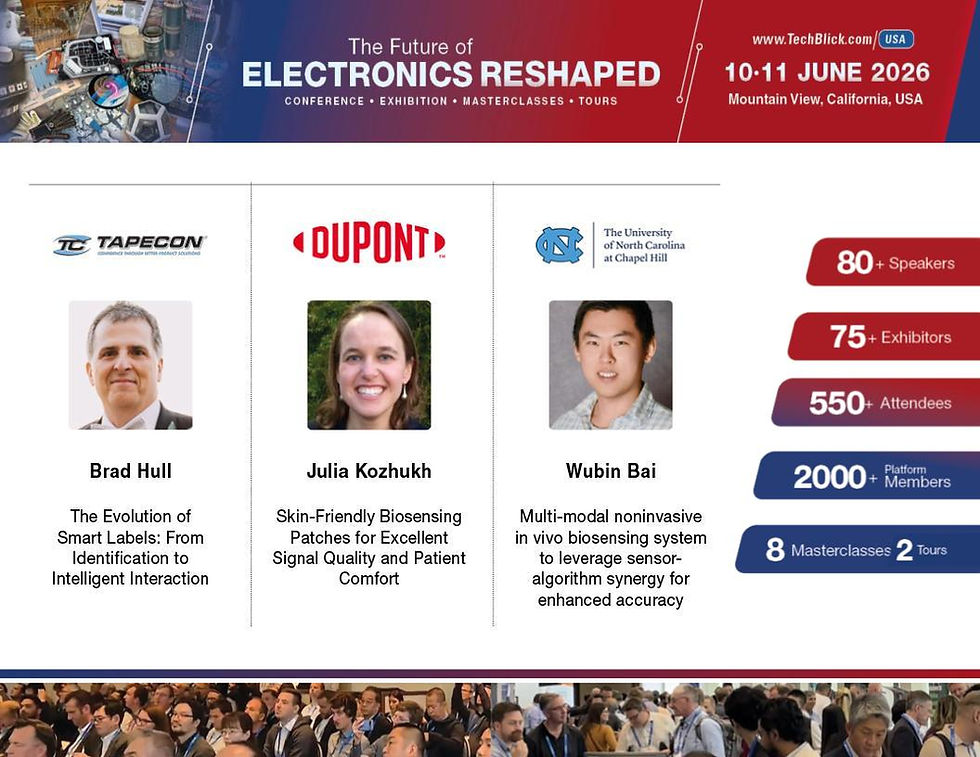
Tapecon | Brad Hull Topic: The Evolution of Smart Labels: From Identification to Intelligent Interaction. Brad explores how standard barcoded identification no longer satisfies the data demands of modern logistics, healthcare, and retail ecosystems. The presentation outlines a versatile toolbox of emerging technologies designed to transform passive packaging into intelligent devices capable of autonomous authentication, sensing, and communication. This work provides original equipment manufacturers (OEMs) with a practical guide to speed up distributed workflows and enable real-time interactive product tracking.
DuPont | Julia Kozhukh Topic: Skin-Friendly Biosensing Patches for Excellent Signal Quality and Patient Comfort. Julia explores the medical and technical challenges of remote cardiac monitoring, where standard patch materials cause skin irritation and suffer from signal degradation during extended patient wear. The talk details an innovative patch design utilizing silicone pressure-sensitive adhesives combined with specialized, silicone-based dry electrodes. This solution delivers an ultra-comfortable, skin-friendly architecture that maintains excellent signal quality to support early clinical detection of post-operative cardiac anomalies.
University of North Carolina | Wubin Bai Topic: Multi-modal noninvasive in vivo biosensing system to leverage sensor-algorithm synergy for enhanced accuracy. Wubin explores the physical limitations of current muscle tracking devices, which are constrained by superficial surface measurements or rigid ultrasound hardware requiring specialized skin coupling. The session introduces a wireless wearable system combining deep-penetrating near-infrared (NIR) light sensors with an integrated inertial measurement unit (IMU). Powered by a recurrent neural network (RNN), this multi-modal platform filters out motion artifacts to deliver highly accurate, non-invasive tracking for rehabilitation feedback and neuromuscular disease diagnostics.
2048 rewards players who recognize that empty space has real tactical value. A single open tile may provide just enough room to complete an important merge or avoid an unwanted chain of blocked positions.
Agario is one of those uncommon games that demonstrates how basic concepts can create fantastic experiences. The basics are simple to grasp, but surviving against hundreds of actual players demands patience, strategy, and quick thinking. Every match reveals a distinct story.
I guess this conference sounds like the kind of event where one conversation can completely change how you see everyday technology. I attended a smaller electronics expo once, and the most memorable part was watching flexible sensors bend without losing function. The agenda here looks packed with practical ideas, from wearable devices to scalable manufacturing. I had a funny contrast recently, researching advanced hardware in the morning and asking, “How do I contact Best Buy customer service for credit card questions?” that afternoon. That is modern life: cutting-edge innovation mixed with errands. Mountain View seems like the perfect place for these discussions.