


22 July 2022
Generations of OLED emitters: fluorescent --> phosphorescent --> TADF --> Hyperfluorescent (HF)
By Piotr Trzaska | Noctiluca | https://noctiluca.eu/ OLED (organic light-emitting diodes) is the display technology based on a thin layer of organic emitters that emit light of a specific color. Key parts of the structure of OLED displays are OLED emitters - the chemical compounds in form of a powder responsible for luminescence - light emission after application of electric current. The quality of the image displayed using OLED technology, the saturation of the color, and the intensity of the light depends for the most part on the emitter parameters, which have evolved with the development of the industry. OLED technologies have been divided into 4 generations, depending on the characteristics of the emitter, which determine the properties of the diode constructed with its use: 1st generation - fluorescent diodes, 2nd generation phosphorescent diodes, 3rd generation based on the TADF effect, and 4th generation based on hyperfluorescence. Noctiluca develops third- and fourth-generation OLED TADF emitter systems, which will become an alternative to existing technology. Why? Let’s find the answer while analyzing all the generations. First generation emitters, so called “fluorescent OLEDs” OLED displays of the first generation are called fluorescent OLEDs and use organic emitters. As the intersystem crossing (ISC) between states of different multiplicity is impossible due to basic laws of physics, only transition S1 -> S0 is allowed and radiative. Upon an electrical excitation...

18 July 2022
Ultrafine printing overview, printed LTCC-based mmWave RFFE, digital printing of screen pastes, 3D..
Ultrafine line screen printing: emerging application and competing technologies TechBlick prepared this presentation for the Advanced Screen Printing Workshop organized by Asada Mesh (June 2022, Chicago). You can watch and read the full presentation here. You can also view the slides. The theme are Existing and emerging applications for ever finer Screen Printing linewidths (sub-15 micron meters): Photovoltaic metallization | MicroLED wrap-around edge electrodes | Fan-out structure for flexible hybrid electronics | Transparent HMIs |Transparent Touch Displays | Edge Electrodes | MLCC | LTCC Hybrid and direct (non-digital) printing technologies towards sub-micron linewidths: Hybrid screen printing (print + etch/ablate) | R2R flexo printing | R2R Gravure Offset Printing |S2S Offset Printing | S2S Reverse Offset Printing |R2R Reverse Offset Printing | R2R Imprinting + Filling | R2R Photolithgraphy You can download the slides at the bottom of this blog. Simply scroll down mmWave 5G RFFE based on LTCC and printed Ag metallization LTCC with printed Ag metallization is an excellent choice for heterogeneous integration of electronics, especially for high-frequency (mmWave and 5G) and harsh environmental conditions. Indeed, it shows our printed electronics can play a role in the 5G/6G communications infrastructure. In this study, DuPont demonstrates an Antenna-in-Package (AiP) which integrates a beam steerable antenna array in a Radio Frequency Front-End module (RFFE) operating at 28...
18 July 2022
Voltera | Rapid Protoyping for Soft and Stretchable Electronics
This is an auto-generated transcript, It has not been proof read by a person threfore they may be errors
Okay. Perfect. Thank you so much for the introduction. Thanks, everybody, for sticking around towards the end. I'm very excited to talk to you today about rapid prototyping for soft and stretchable electronics. So a little bit about me. I'm a product manager at Volterra. I have a background in nanotechnology, joined Volterra in 2014, have been a materials scientist, a product engineer, electromechanical design engineer, and now I'm leading our entry into next generation electronics at Volterra. If you haven't heard of Volterra in 2015, we created a circuit board printer that would help electronics engineers speed up their development time. We were inspired by how 3D printing could use, could bring ideation to concept for mechanical design. And we really wanted to do the same thing for electronics focusing on the PCB manufacturing process. However, shortly after we launched the product over the next couple of years, we spoke to our users and found that they were really surprising us with what they were doing. So these weren't the electronics engineers or some of them weren't the electronics engineers and product developers that we'd initially imagined using this. These were researchers and scientists at world leading institutions who are really pushing the boundaries of what was possible with electronics. And from that, we learned a lot about what could be possible when ...
13 July 2022
New anode concepts for solid state batteries
Speaker: Susanne Doerfler| Company: Fraunhofer IWS | Date: 9-10 Feb 2022 | Full Presentation The lithium/ electrolyte interphase is still a bottleneck for efficient and reversible ionic transport in solid state batteries. In this presentation alternative anode concepts based on 100 % silicon, silicon/carbon composites and porous carbons will be introduced. All material concepts have been investigated in thiophosphate-based solid state batteries and performance data will be discussed. Join TechBlick on an annual pass to join all live online conference or online version of onsite conference access library of on-demand talks (600 talks + PDFs) portfolio of expert led masterclass year-round platform https://www.techblick.com/ Our next battery-related event will take place on 15-16 FEB 2023, covering 1) Solid-State Batteries: Innovations, Promising Start-Ups, & Future Roadmap 2) Battery Materials: Next-Generation & Beyond Lithium Ion The speakers include: General Motors, Graphenix Development, Brookhaven National Laboratory, Fraunhofer IKTS, RWTH Aachen University, Lawrence Livermore National Laboratories, Meta Materials Inc, Skeleton Technologies, Solid State Battery Inc, Argonne National Laboratories, OneD Battery Sciences, VTT, Leyden Jar Technologies B.V., b-Science, Rho Motion, Wevo-Chemie, LiNA Energy, CNM Technologies, Ionblox, Empa, Zinc8 Energy Solutions, Avicenne Energy, Echiontech, South8 Technologies, Basquevolt, NanoXplore, Chasm, Li Metal,...
21 July 2022
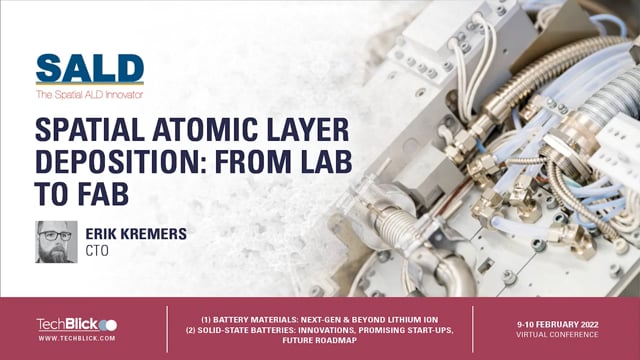
Spatial Atomic Layer Deposition: From Lab to Fab
Speaker: Erik Kremers | Company: SALD | Date: 9-10 Feb 2022 | Full Presentation In all growth markets, maximum throughput at the lowest possible costs is essential for success! SALD has developed a unique technology that makes this possible, which is protected by several patents. This technology has been incorporated into a compact machine that can be used for research as well as for small-scale production. It does not matter which material is involved: battery electrode, solar cell, OLED or foil. Moreover, SALD is the only company in the world that has the expertise to subsequently quickly and reliably upscale the Spatial ALD technology to high volume production. In Spatial ALD (SALD) precursors are continuously supplied in different locations and kept apart by an inert gas region or zone. Film growth is achieved by exposing the substrate to the locations containing the different precursors. The process is very fast and compatible with fast-throughput techniques such as roll-to-roll (R2R) and is versatile and cheap to scale up. In addition, one of the main assets of SALD is that it can be performed at ambient pressure and even in the open air, while not compromising the deposition rate. Join TechBlick on an annual pass to join all live online conference or online version of onsite conference access library of on-demand talks (600 talks + PDFs) portfolio of expert led masterclass year-round platform https://www.techblick.com/ Our next battery-related event wi...

18 July 2022
Ultrafine line printing: technologies and applications
This presentation was developed for the Advanced Screen Printing Workshop organized by Asada Mesh. The theme was fineline printing. In this presentation, we discuss the following: Existing and future applications for ever finer Screen Printing Linewidths (sub-15micron meters). Photovoltaic metallization MicroLED wrap-around edge electrodes Fan-out structure for flexible hybrid electronics Transparent HMIs Transparent Touch Displays Edge Electodes MLLC LTCC Hybrid and direct (non-digital) printing technologies towards sub-micron linewidths Hybrid screen printing (print + etch/ablate) R2R flexoprinting R2R Gravure Offset PRinting S2S Offset Printing S2S Reverse Offset Printing R2R Reverse Offset Printing R2R Imprinting + Filling R2R Photolithgraph
You can download the slides at the end. Please scroll down
This is an automatic transcription of the full presentation. It has not been proof read so there may be errors. This is here to help in case you prefer to read Hello, everyone. My name is Kasha. I am the CEO of TechBlick. We are really the home of the global community for additive electronics, for printed flexible hybrid electronics, 3D electronics. And we provide our community members a year round programme of curated onsite and online conferences and masterclasses market studies and beyond.
The presentation itself has two parts. So the first part. The presentation will be looking at applications which will benefit or which will require ever finer screen printed line ...

18 July 2022
Bringing Flexible Hybrid Electronics to the Market
Speaker: Girish Wable | Company: Jabil| Date: 10-11 March 2021 | Full Presentation Bio With a Bachelor of Science in Mechanical Engineering and a Master of Science in Industrial Engineering, Girish Wable is a technology, operations, sourcing and business solutions strategist for Jabil. With more than 25 years of global experience in electronics manufacturing, high performance coatings, material handling, automation, additive manufacturing, printed electronics and digital transformation, Girish leads up strategic business and technical initiatives for Jabil. Girish, who started as an intern with Jabil, has authored several engineering publications, received multiple patents and enjoys engaging with ecosystem partners and research institutions to further the technology. Girish regularly contributes to engineering articles, reviews technical proposals, serves as advisory board, write blogs for Jabil.com and has been a keynote speaker at multiple conferences. Join TechBlick on an annual pass to join all live online conference or online version of onsite conference access library of on-demand talks (600 talks + PDFs) portfolio of expert led masterclass year-round platform https://www.techblick.com/ And do NOT miss our flagship event in Berlin on 17-18 OCT 2023 focused on Reshaping the Future of Electronics. This event attracts 550-600 participants from all the world and offers a superb ambience and dynamic exhibition floor. To learn more visit https://www.techblick.com/electroni...

11 July 2022
Electroninks | Particle-free Ag, Au & Pt Inks For Printed Electronics with Digital Additive Printing
Yuan Gu and Ayan Maity - Senior Scientists, Electroninks As the world of electronics continues to change shape – literally, and products become wearable, flexible, foldable, and capable of processing data at the same time, the demand for the tiny circuitry that makes this all possible has hit a tipping point, creating a need for innovative solutions. Advancements in additive manufacturing are dictating the shape, size and even purpose of new products yet to be created by consumer and industrial companies. Electroninks' particle-free inks - along with the next generation of NanoJet provided by the Integrated Deposition Solution (IDS) system - allows for the fabrication of sensors and circuits. The combination of Electroninks’ particle-free inks and IDS NanoJet provides a higher mass output, better printing quality, and lower cost to fabricate electronics compared with other traditional digital printing technologies. Particle-free Cu, Ni, Ag, Au and Pt conductive inks from Electroninks, Inc. (based in Austin, TX) are metallo-organic-based inks that provide superior performance and reliability compared to nanoparticle-based inks. Particle-free inks consisting of metal-organic precursors typically have better performance because they reduce metal films more cleanly, often at lower temperature. Final films do not contain organic components and tend to survive stress/adhesion tests which increase their reliability to moisture sensitivity level (MSL) and aerospace standards. Particl...