


31 March 2022
Tiny battery-free devices float in the wind like dandelion seeds
Wireless sensors can monitor how temperature, humidity, or other environmental conditions vary across large swaths of land, such as farms or forests. These tools could provide unique insights for a variety of applications, including digital agriculture and monitoring climate change. One problem, however, is that it is currently time-consuming and expensive to physically place hundreds of sensors across a large area. Inspired by how dandelions use the wind to distribute their seeds, a University of Washington team has developed a tiny sensor-carrying device that can be blown by the wind as it tumbles toward the ground. This system is about 30 times as heavy as a 1-milligram dandelion seed but can still travel up to 100 meters in a moderate breeze, about the length of a football field, from where it was released by a drone. Once on the ground, the device, which can hold at least four sensors, uses solar panels to power its onboard electronics and can share sensor data up to 60 meters away. The team published these results in Nature. “We show that you can use off-the-shelf components to create tiny things. Our prototype suggests that you could use a drone to release thousands of these devices in a single drop. They’ll all be carried by the wind a little differently, and basically, you can create a 1,000-device network with this one drop,” said senior author Shyam Gollakota, a UW professor in the Paul G. Allen School of Computer Science & Engineering. “This is amazing and tr...

30 March 2022
Liquid electronics: Wrapping droplets in graphene for printed microchips and wearable sensors
New research from physicists at the University of Sussex will 'significantly advance' the new technology area of liquid electronics, enhancing the functionality and sustainability of potential applications in printed electronics, wearable health monitors, and even batteries. In their research paper published in ACS Nano, the Sussex scientists have built on their previous work to wrap emulsion droplets with graphene and other 2D materials by reducing the coatings down to atomically-thin nanosheet layers. In doing so they were able to create electrically-conducting liquid emulsions that are the lowest-loading graphene networks ever reported -- just 0.001 vol%.
This means that the subsequent liquid electronic technology -- whether that might be strain sensors to monitor physical performance and health, electronic devices printed from emulsion droplets, and even potentially more efficient and longer-lasting electric vehicle batteries, will be both cheaper and more sustainable because they will require less graphene or other 2D nanosheets coating the droplets.
Another significant development was that the scientists can now make these electronic droplet networks using any liquids -- whereas previous research focused on conventional oils and water -- because they have discovered how to control which liquid droplets are wrapped in graphene, meaning that they can design the emulsions specifically to the desired application.
Research Fellow in Material Physics in the University ...

28 March 2022
New lightweight super material could battle bullets, deflect space debris
University of Wisconsin–Madison engineers have created a nanofiber material that outperforms its widely used counterparts — including steel plates and Kevlar fabric — in protecting against high-speed projectile impacts. Basically, it’s better than bulletproof. “Our nanofiber mats exhibit protective properties that far surpass other material systems at a much lighter weight,” says Ramathasan Thevamaran, a UW–Madison assistant professor of engineering physics who led the research. He and his collaborators detailed the advance in a paper published recently in the journal ACS Nano. To create the material, Thevamaran and postdoctoral researcher Jizhe Cai mixed multi-walled carbon nanotubes — carbon cylinders just one atom thick in each layer — with Kevlar nanofibers. The resulting nanofiber mats are superior at dissipating energy from the impact of tiny projectiles moving faster than the speed of sound. The advance lays the groundwork for carbon nanotube used in lightweight, high-performance armor materials, for example, in bulletproof vests to better protect the wearer or in shields around spacecraft to mitigate damage from flying high-speed microdebris. “Nano-fibrous materials are very attractive for protective applications because nanoscale fibers have outstanding strength, toughness, and stiffness compared to macroscale fibers,” Thevamaran says. “Carbon nanotube mats have shown the best energy absorption so far, and we wanted to see if we could further improve their perfo...
23 March 2022
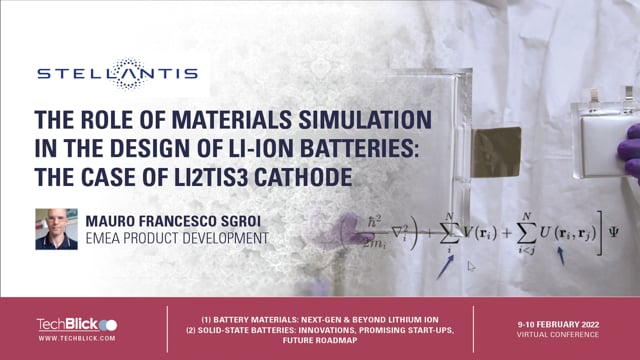
The role of materials simulation in the design of Li-ion batteries: the case of Li2TiS3 cathode
Speaker: Mauro Francesco Sgroi | Company: Stellantis | Date: 9-10 Feb 2022 | Full Presentation The current worldwide effort to electrify the private transport sector is based on the availability of Li-ion cells with high specific energy, long cycle life and acceptable cost. Electrodes and electrolytes materials play a fundamental role in determining the performances of Li-ion cells. The use of critical raw materials, such as cobalt and graphite, is a crucial aspect for the LIBs market and novel materials have to be developed. Computational materials science is widely used to design new materials and to optimize the properties of the existing ones: in the field of Li-ion cells this approach led to a deeper understanding of many chemical-physical phenomena associated with the operation of the cell. After a general introduction, the main computational approaches to simulate the Li-ion cells materials will be presented including DFT methods and molecular dynamics. Finally the talk will concentrate on the development of a robust and predictive DFT method for the description of a disordered cubic Li2TiS3 system, a cobalt-free high capacity material showing promising properties as cathode in all-solid-state Li batteries. Join TechBlick on an annual pass to join all live online conference or online version of onsite conference access library of on-demand talks (600 talks + PDFs) portfolio of expert led masterclass year-round platform https://www.techblick.com/ Our ne...
31 March 2022
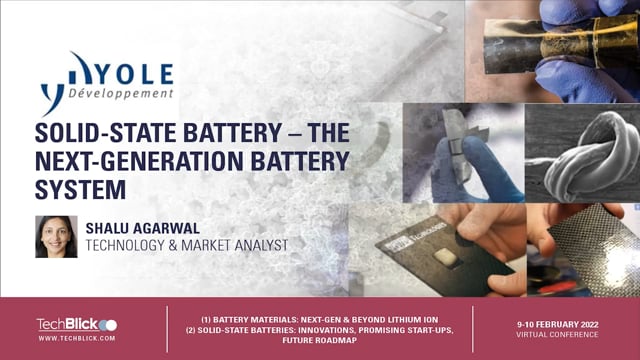
Solid-state battery – the next-generation battery system
Speaker: Shalu Agarwal | Company: Yole | Date: 9-10 Feb 2022 | Full Presentation Li-ion batteries have become the primary technology of choice for many applications in the consumer electronics industry and empowered the electric vehicle (EV). However, the flammable liquid electrolyte of Li-ion battery is responsible for safety issues, such as electrolyte leakage, fire, or explosion. In addition, the demand for higher energy density, fast charging capability, lower cost, and safer EVs has recently created a resurgence of interest in solid-state batteries. In its talk, Yole Développement will present the advantages of solid-state batteries over conventional Li-ion batteries as well as the challenges associated with their development, like low ionic conductivity, poor wettability of solid electrolytes, high operating temperature, etc. Solid-state battery manufacturers must achieve battery production processes that are scalable and compatible with existing lithium-ion production technology to remain successful in the overfilled market. Bringing solid-state technology to mass production is a difficult task. Therefore, partnerships are more important than ever to get all the necessary solid-state battery know-how together: technology, equipment, high-volume / high-yield production, and end-systems. Today, many batteries and automotive manufacturers have presented their target roadmaps for mass production to secure a leadership role in the solid-state battery market despite the rema...

29 March 2022
Colorfully detecting stressed-out polymer films, gels before they break
Stretchy films and squishy gels help make wearable electronics, soft robotics, and biocompatible tissues a reality. But too much force can cause these polymers to break apart without warning. To detect stress before it’s too late, researchers reporting in the Journal of the American Chemical Society show they have designed a compound with “wings” that makes these materials change color when they are stretched or crushed. Plasticky films and polymer gels — soft 3D networks filled with liquids — can be bendable, stretchable, or compressible. And while most polymer films only snap apart when pulled too far, many gels aren’t very strong, cracking under relatively small amounts of pressure. Yet there isn’t a way to predict how tough the spongy material will be. In previous research, Shohei Saito and colleagues developed V-shaped molecules, known as flapping molecular (FLAP) force probes. FLAPs have two side structures resembling wings that flatten under pressure, causing a color change from blue to green fluorescence. This probe worked as expected when incorporated into a polyurethane film, but when added to a liquid-soaked polymer gel, the compound spontaneously turned fluorescent green without any external force. So, Saito and Takuya Yamakado set out to improve the FLAP molecule so that it would accurately detect mechanical stresses in both a polymer gel and a film.
The researchers modified their earlier version by replacing the two anthraceneimide wings with pyreneimide on...

28 March 2022
Applications Utilising Roll to Roll Fexible Hybrid Electronics
Speaker: Steven Bagshaw | Company: CPI | Date: 11-12 May 2021 | Full Presentation Bio Steve is responsible for business development activities across CPI’s printed electronics platform. Steve’s expertise lies in the area of printed electronics, printed sensing and its role in the development of the internet of things and industry 4.0. Steve has delivered on a number of successful private projects at CPI, helping new research ideas develop from prototype and through to commercial deployment. Clients include industries such as automotive, aerospace, defence, packaging and medtech. These projects involve working with companies of all sizes ranging from large corporates to SMEs and academia. Previously Steve held marketing positions at CPI, where he was responsible for managing the marketing operations of CPI’s printable electronics division. Steve’s role was to provide an end user focus in the scale up and commercialisation of products and processes related to printable electronics. He has extensive knowledge in emerging technology areas such as intelligent print, printed lighting and enabling technologies such as materials integration and barrier encapsulation. Prior to joining CPI in 2008, Steve graduated from Northumbria University in Business Studies and is currently studying an Executive MBA at Warwick Business School. Join TechBlick on an annual pass to join all live online conference or online version of onsite conference access library of on-demand talks (600 talks + PDF...
21 March 2022
High-Resolution Printing from 2D to 3D for Additive Manufacturing of Printed Electronics
Speaker: Doyoung Byun | Company: ENJET Inc| Date: 11-12 May 2021 | Full Presentation Bio Doyoung Byun received the PhD degree in Mechanical and Aerospace Engineering from the Korea Advanced Institute of Science and Technology (KAIST), Korea, in 2000. He has worked in several institutes and academies and founded the Enjet in 2009 in order to commercialize his high resolution printing and coating technologies for the printed electronics. Since 2009, he has served as CEO in the Enjet. He has developed the novel femto-liter droplet dispensing technology, electrostatic spray nozzle for functional coating, micro-fluidic devices, and MEMS devices. Based on these core technologies, he could commercialize ultra-fine printing and spray coating solutions for OLED display, micro-LED display, mobile phone, and bio-medical applications. The Enjet is a high resolution inkjet printing solution leader and has a vision to provide innovative tools of printed electronics (2D and 3D), replacing conventional vacuum processes in OLED, PCB, Semiconductor, Glass, Bio-medical, and energy industries. The Enjet has further dreams to develop 3D additive manufacturing solutions for printed electronics. The Enjet has been developing a high resolution inkjet head with multi-nozzles, which can dispense higher viscous ink than the conventional ones and form pico-liter or even femto-liter droplets. With this novel inkjet head, we can print and manufacture 3D electronic devices from the provided model data and ...