



19 January 2022
The multilayer approach to solid-state battery electrolytes
- Transforming traditional battery architecture
Speaker: Gregory Hitz | Company: ION Storage Systems | Date: 9-10 Feb 2022 | Full Presentation Solid-state battery cells offer the ability to host high energy density lithium metal while affording safety above that of state-of-the-art lithium-ion cells due to the use of non-flammable electrolytes and dense layers that cannot be easily punctured by lithium dendrites. Ion Storage Systems (ION) employs a high-ionic conductivity garnet-based electrolyte capable of lithium metal plating without degradation at a wide range of operating temperatures. In many solid-state cell architectures pursued to date, lithium metal plating directly leads to cell internal volume changes. Ensuring consistent lithium plating over a planar surface necessitates external compression which can add to cell and pack overhead costs while decreasing the overall specific energy density of the system as a whole. ION’s solid-state electrolyte is incorporated into cells in a bilayer structure that allows lithium to plate within the confines of a porous ceramic layer which is sintered on a cathode-separating dense ceramic layer. This structure enables constant-volume cells which can host a multitude of cathodes and enable simplified application integration, high energy density and prolonged cycle life. Join TechBlick on an annual pass to join all live online conference or online version of onsite conference access library of on-demand talks (600 talks + P...

18 January 2022
Printed, Hybrid, InMold, and 3D Electronics
Agenda | 9-10 March 2022 TechBlick is delighted to announce the world-class agenda for its 2-day conference and exhibition on Printed, Hybrid, InMold, and 3D Electronics. This 2-day event will take place LIVE (online) on 9-10 March 2022 in our very engaging and interactive 'in-person virtual' space, making virtual interaction real and bringing together leading OEMs, manufacturers, material suppliers, and innovators. Themes include: Printed | Flexible | Additive | Hybrid | 3D | Structural | R2R | InMold | Textiles | Stretchable | Conformal | Wearable | Package Level Electronics | Conductive, Dielectric and Adhesives Inks | LIFT | Inkjet | Advanced Screen Print | Electrohydrodynamic | Aerosol | Nanoimprint | HMI | Smart Skin Patches | Perovskite and Organic Photovoltaics| Flexible Substrates and Barriers | Printed Sensors and Actuators | Printed Displays | Low Temperature Attachment | Heat- and Photo-sintering Leading Global Speakers Include The world-class speaker line-up brings together end-users and OEMs, manufacturers, as well as innovative start-ups from around the world. See the latest agenda here Furthermore, a LIVE exhibition will take place in parallel to the conference tracks, enabling you to meet the exhibitors live, network with other participants, and connect with OEMs and end-users. This will be truly a global gathering, bringing the entire printed, hybrid, in-mould, and 3D electronics community together. Click here to see how our buzzing virtual exhibition...

17 January 2022
New Generation Of Photovoltaic Materials
Speaker: Jean-Rémi Pouliot | Company: Brilliant Matters | Date: 11-12 May 2021 | Full Presentation Join TechBlick on an annual pass to join all live online conference or online version of onsite conference access library of on-demand talks (600 talks + PDFs) portfolio of expert led masterclass year-round platform https://www.techblick.com/ And do NOT miss our flagship event in Berlin on 17-18 OCT 2023 focused on Reshaping the Future of Electronics. This event attracts 550-600 participants from all the world and offers a superb ambience and dynamic exhibition floor. To learn more visit https://www.techblick.com/electronicsreshaped To see feedback about previous event see https://www.techblick.com/events-agenda...
14 January 2022
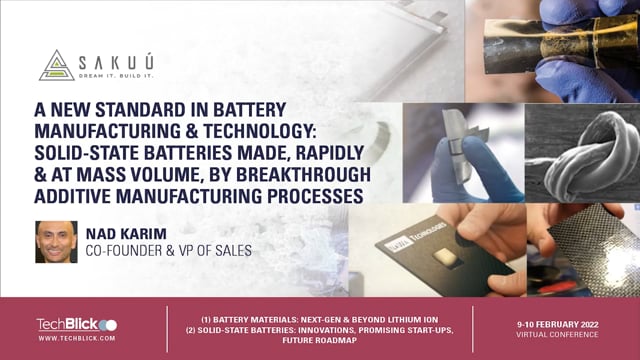
Additively manufactured solid state batteries: revolutionising the production process
Speaker: Nad Karim | Company: Sakuu Corporation | Date: 9-10 Feb 2022 | Full Presentation Join TechBlick on an annual pass to join all live online conference or online version of onsite conference access library of on-demand talks (600 talks + PDFs) portfolio of expert led masterclass year-round platform https://www.techblick.com/ Our next battery-related event will take place on 15-16 FEB 2023, covering 1) Solid-State Batteries: Innovations, Promising Start-Ups, & Future Roadmap 2) Battery Materials: Next-Generation & Beyond Lithium Ion The speakers include: General Motors, Graphenix Development, Brookhaven National Laboratory, Fraunhofer IKTS, RWTH Aachen University, Lawrence Livermore National Laboratories, Meta Materials Inc, Skeleton Technologies, Solid State Battery Inc, Argonne National Laboratories, OneD Battery Sciences, VTT, Leyden Jar Technologies B.V., b-Science, Rho Motion, Wevo-Chemie, LiNA Energy, CNM Technologies, Ionblox, Empa, Zinc8 Energy Solutions, Avicenne Energy, Echiontech, South8 Technologies, Basquevolt, NanoXplore, Chasm, Li Metal, Sila Nanotechnologies, Quantumscape (tentative), Fraunhofer ISI, etc https://www.techblick.com/...

18 January 2022
Continuous quality control can be done during the production of graphene
A Christmas tree with a thickness of one atom was made at DTU. It shows how terahertz measurements can be used to ensure the quality of graphene.
The Christmas tree in the pictures is 14 centimeters long. Since it is made of graphene, it consists of carbon atoms in only one layer and is only a third of a nanometer thick. It is cut out of a 10-meter long roll of graphene, transferred in one piece using a rebuilt laminating machine, and then scanned with terahertz radiation.
The experiment shows that continuous quality control can be done during the production of graphene, which is expected to play a significant role in future high-speed electronics, i.e. medical instruments, and sensors.
Graphene is a so-called two-dimensional material, i.e. it consists of atoms in one cohesive layer that is only one atom thin. It is more robust, stiffer, and better at conducting electricity and heat than any other material we know of. Therefore, graphene is an obvious candidate for electronic circuits that take up less space, weigh less, are bendable, and are more efficient than the electronics we know today.
“Even if you could make a pencil drawing of a Christmas tree and lift it off the paper—which, figuratively, is what we have done—it would be much thicker than one atom. A bacterium is, e.g. 3000 times thicker than the graphene layer we used. That’s why I dare call this the world’s thinnest Christmas tree. And although the starting point is carbon, just like the graphite in a penc...

17 January 2022
Solid-state, Si-anode, Graphene, LiSand Other Frontier Battery Materials
TechBlick: Year-Round Platform For Learning, Training, & Networking On Emerging Technologies Annual Pass: 12-month access to all LIVE (online) TechBlick events, all networking opportunities, masterclasses, and the library of past state-of-the-art presentation Solid State Batteries & Frontier Battery Materials 9 - 10 February 2022 | 14:00 - 20:00 CET | Virtual Event Platform Themes: Solid-State Batteries | Next-Gen and Beyond Li-Ion | Promising Start-Ups | Market Forecasts | Start-Up Landscape Analysis | Scale-Up Techniques and Successes | Roll-to-Roll | Emerging Solid-State Electrolyte Material Families | Pure and Composite Silicon Anodes | AI and Simulation in Material Discovery and Optimization | LiS | Graphene, CNTs, and VACNTs | Reactive Metals | Existing Emerging Novel Cathodes Materials for Li-ion and SSBs | Aqueous, Binder-Free and/or Green Solutions | 3D Batteries | Additively Manufactured Batteries | Dry Electrode Technology Printed, Hybrid, InMold, & 3D Electronics 9 - 10 March 2022 | 13:00 - 20:00 CET | Virtual Event Platform...

14 January 2022
Energy-saving glass ‘self-adapts’ to heating and cooling demand
An international research team led by scientists from Nanyang Technological University, Singapore (NTU Singapore) has developed a material that, when coated on a glass window panel, can effectively self-adapt to heat or cool rooms across different climate zones in the world, helping to cut energy usage. Developed by NTU researchers and reported in the top scientific journal Science, the first-of-its-kind glass automatically responds to changing temperatures by switching between heating and cooling. The self-adaptive glass is developed using layers of vanadium dioxide nanoparticles composite, Poly(methyl methacrylate) (PMMA), and low-emissivity coating to form a unique structure that could modulate heating and cooling simultaneously. The newly developed glass, which has no electrical components, works by exploiting the spectrums of light responsible for heating and cooling. During summer, the glass suppresses solar heating (near-infrared light), while boosting radiative cooling (long-wave infrared) - a natural phenomenon where heat emits through surfaces towards the cold universe - to cool the room. In the winter, it does the opposite to warm up the room. In lab tests using an infrared camera to visualize results, the glass allowed a controlled amount of heat to emit in various conditions (room temperature – above 70°C), proving its ability to react dynamically to changing weather conditions. New glass regulates both heating and cooling Windows are one of the key compone...

13 January 2022
First fully 3D-printed, flexible OLED display
In a groundbreaking new study, researchers at the University of Minnesota Twin Cities used a customized printer to fully 3D print a flexible organic light-emitting diode (OLED) display. The discovery could result in low-cost OLED displays in the future that could be widely produced using 3D printers by anyone at home, instead of by technicians inexpensive microfabrication facilities. The research is published in Science Advances, a peer-reviewed scientific journal published by the American Association for the Advancement of Science (AAAS). The OLED display technology is based on the conversion of electricity into light using an organic material layer. OLEDs function as high-quality digital displays, which can be made flexible and used in both large-scale devices such as television screens and monitors as well as handheld electronics such as smartphones. OLED displays have gained popularity because they are lightweight, power-efficient, thin and flexible, and offer a wide viewing angle and high contrast ratio. “OLED displays are usually produced in big, expensive, ultra-clean fabrication facilities,” said Michael McAlpine, a University of Minnesota Kuhrmeyer Family Chair Professor in the Department of Mechanical Engineering and the senior author of the study. “We wanted to see if we could basically condense all of that down and print an OLED display on our table-top 3D printer, which was custom built and costs about the same as a Tesla Model S.” The group had previous...