


4 January 2022
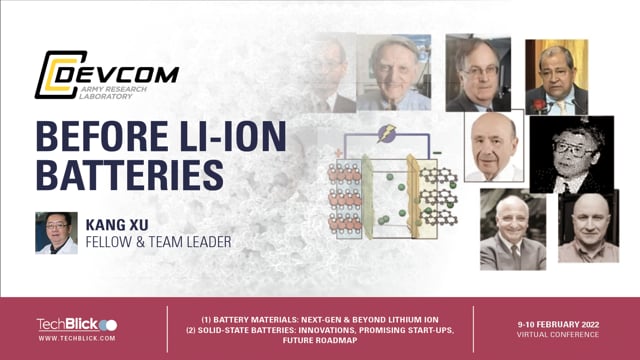
Before Li-ion Batteries
Speaker: Kang Xu | Company: US Army Research Lab | Date: 9-10 Feb 2022 | Full Presentation Join TechBlick on an annual pass to join all live online conference or online version of onsite conference access library of on-demand talks (600 talks + PDFs) portfolio of expert led masterclass year-round platform https://www.techblick.com/ Our next battery-related event will take place on 15-16 FEB 2023, covering 1) Solid-State Batteries: Innovations, Promising Start-Ups, & Future Roadmap 2) Battery Materials: Next-Generation & Beyond Lithium Ion The speakers include: General Motors, Graphenix Development, Brookhaven National Laboratory, Fraunhofer IKTS, RWTH Aachen University, Lawrence Livermore National Laboratories, Meta Materials Inc, Skeleton Technologies, Solid State Battery Inc, Argonne National Laboratories, OneD Battery Sciences, VTT, Leyden Jar Technologies B.V., b-Science, Rho Motion, Wevo-Chemie, LiNA Energy, CNM Technologies, Ionblox, Empa, Zinc8 Energy Solutions, Avicenne Energy, Echiontech, South8 Technologies, Basquevolt, NanoXplore, Chasm, Li Metal, Sila Nanotechnologies, Quantumscape (tentative), Fraunhofer ISI, etc https://www.techblick.com/...

3 January 2022
Photoactive Polymers Tailored to Industrial Printing of High Performing
and Stable Organic Photovoltaics Speaker: Reed Eisenhart | Company: Phillips 66 | Date: 11-12 May 2021 | Full Presentation Join TechBlick on an annual pass to join all live online conference or online version of onsite conference access library of on-demand talks (600 talks + PDFs) portfolio of expert led masterclass year-round platform https://www.techblick.com/ And do NOT miss our flagship event in Berlin on 17-18 OCT 2023 focused on Reshaping the Future of Electronics. This event attracts 550-600 participants from all the world and offers a superb ambience and dynamic exhibition floor. To learn more visit https://www.techblick.com/electronicsreshaped To see feedback about previous event see https://www.techblick.com/events-agenda...

22 December 2021
Skintronics deliver high precision and continuous, wireless monitoring with comfort & flexibility
This portable stress monitor, SKINTRONICS, is a comfortable, wearable device that utilizes fully stretchable, wireless skin-conformal bioelectronics, designed to provide precise readings of heart rate and sweat gland activity via galvanic skin response. Georgia Tech’s thin, conductive film and flexible layered electrodes with nanomembrane sensors create an impressive device that weighs less than 7 g, including its rechargeable battery. Other galvanic skin response wearable monitors may weigh (in volume) six times more than this technology or greater.
Where other devices lack the ability to maintain adequate contact without pressure from a band or strap, this adaptable stress monitor can be applied directly to the skin and fits snugly to the natural curvature of the body at the wrist or shoulder. The bioelectric wearable device is designed for greater comfort—it is soft, thin, and less than 5 mm thick. The durability and performance of the portable stress monitor have been tested to confirm that it can endure the daily wear of its users.
The quality of the data output of the high-sensitivity nanomembranes in this novel device was also tested and measured to be comparable, if not superior when concurrently compared to two commercially available devices. Georgia Tech’s portable stress monitor is designed to provide more accurate ongoing measurements and delivers an improved wearable design so that cardiac patients, infants in the pediatric intensive care unit (PICU), or even...

20 December 2021
New simulator predicts if changes to materials/designs will improve the performance of the new OPV
In the ongoing race to develop ever-better materials and configurations for solar cells, there are many variables that can be adjusted to try to improve performance, including material type, thickness, and geometric arrangement. Developing new solar cells has generally been a tedious process of making small changes to one of these parameters at a time. While computational simulators have made it possible to evaluate such changes without having to actually build each new variation for testing, the process remains slow. Now, researchers at MIT and Google Brain have developed a system that makes it possible not just to evaluate one proposed design at a time, but to provide information about which changes will provide the desired improvements. This could greatly increase the rate for the discovery of new, improved configurations. The new system, called a differentiable solar cell simulator, is described in a paper published today in the journal Computer Physics Communications, written by MIT junior Sean Mann, research scientist Giuseppe Romano of MIT’s Institute for Soldier Nanotechnologies, and four others at MIT and at Google Brain. Traditional solar cell simulators, Romano explains, take the details of a solar cell configuration and produce as their output a predicted efficiency — that is, what percentage of the energy of incoming sunlight actually gets converted to an electric current. But this new simulator both predicts the efficiency and shows how much that output i...

3 January 2022
Low-cost intelligent soil sensors could help farmers curb fertilizer use
Smart sensing technology to help farmers use fertilizer more effectively and reduce environmental damage has been created by Imperial bioengineers. The technology, which is described in Nature Food, could help growers work out the best time to use fertilizer on their crops and how much is needed, considering factors like the weather and soil condition. This would reduce the expensive and environmentally damaging effects of overfertilizing soil, which releases the greenhouse gas nitrous oxide and can pollute soil and waterways. Overfertilisation has so far rendered 12 percent of once-arable land worldwide unusable and the use of nitrogen-based fertilizer has risen by 600 percent in the last 50 years. However, it is difficult for crop growers to precisely tailor their own fertilizer use: too much and they risk environmental damage and money wastage; too little and they risk poor crop yields. The researchers behind this new sensing technology say it could provide benefits for both the environment and growers. The sensor, named chemically functionalized paper-based electrical gas sensor (chemPEGS), measures levels of ammonium in soil – the compound that is converted to nitrites and nitrates by soil bacteria. Using a type of AI called machine learning, it combines this with weather data, time since fertilization, pH, and soil conductivity measurements. It uses these data to predict how much total nitrogen the soil has now and how much it will have up to 12 days in the future, to...
27 December 2021
Recent EMI Shielding Process for Advanced Packaging
Speaker: Vinicius Zanchin | Company: Ntrium | Date: 11-12 May 2021 | Full Presentation Join TechBlick on an annual pass to join all live online conference or online version of onsite conference access library of on-demand talks (600 talks + PDFs) portfolio of expert led masterclass year-round platform https://www.techblick.com/ And do NOT miss our flagship event in Berlin on 17-18 OCT 2023 focused on Reshaping the Future of Electronics. This event attracts 550-600 participants from all the world and offers a superb ambience and dynamic exhibition floor. To learn more visit https://www.techblick.com/electronicsreshaped To see feedback about previous event see https://www.techblick.com/events-agenda...

21 December 2021
Bendable solar cells match the power/weight ratio of best commercial thin-film devices
Silicon dominates the solar power landscape, but it isn’t the best material for making thin, lightweight solar cells needed for satellites and drones. Atomically thin semiconducting materials such as tungsten diselenide and molybdenum disulfide, which are already being considered for next-generation electronics, hold promise for low-cost ultrathin solar cells that can also be flexible. And now, engineers have made tungsten diselenide solar cells that boast a power-per-weight ratio on par with established thin-film solar cell technologies.
The flexible solar cells reported in the journal Nature Communications have a light-to-electricity conversion efficiency of 5.1 percent, the highest reported for flexible cells of this kind. Their specific power, meanwhile, is 4.4 W/g, comparable with thin-film solar cells—such as those made of cadmium telluride, copper indium gallium selenide, amorphous silicon, and III-V semiconductors. With further engineering to reduce the substrate thickness and increase efficiency, the technology has the potential to get to 46 W/g, “way beyond what has been shown for other photovoltaic technologies,” says Koosha Nassiri Nazif, an electrical engineer at Stanford University who led the work with his colleague Alwin Daus. It’s a thousand times thinner than silicon but with the same amount of absorption as a standard silicon wafer.
Silicon’s efficiency is hard to beat for the cost, and silicon solar panel costs have been dropping every year. But “si...
20 December 2021
Ultralow Temperature Solder For Flexible Hybrid Electronics
Speaker: Rahul Raut | Company: Alpha Assembly | Date: 11-12 May 2021 | Full Presentation Join TechBlick on an annual pass to join all live online conference or online version of onsite conference access library of on-demand talks (600 talks + PDFs) portfolio of expert led masterclass year-round platform https://www.techblick.com/ And do NOT miss our flagship event in Berlin on 17-18 OCT 2023 focused on Reshaping the Future of Electronics. This event attracts 550-600 participants from all the world and offers a superb ambience and dynamic exhibition floor. To learn more visit https://www.techblick.com/electronicsreshaped To see feedback about previous event see https://www.techblick.com/events-agenda...