


22 November 2021
Printed Electronics made with Digital Printing: Materials and Applications in Motor Sport
Speaker: Jurgen van Peer | Company: Nanogate | Date: 11-12 May 2021 | Full Presentation Digital printing has clearly established itself for graphics printing, thanks to the advantages it offers over traditional processes like screen printing. More recently, digital printing started morphing into digital manufacturing and also Printed Electronics is taking advantage of that evolution. In this talk we will review Agfa's digital conductive inks based on nanomaterials, and highlight some features of newly developed inks. In the second part of the talk, Nanogate Netherlands will discuss the application of additive digital manufacturing in motor sport products. Join TechBlick on an annual pass to join all live online conference or online version of onsite conference access library of on-demand talks (600 talks + PDFs) portfolio of expert led masterclass year-round platform https://www.techblick.com/ And do NOT miss our flagship event in Berlin on 17-18 OCT 2023 focused on Reshaping the Future of Electronics. This event attracts 550-600 participants from all the world and offers a superb ambience and dynamic exhibition floor. To learn more visit https://www.techblick.com/electronicsreshaped To see feedback about previous event see https://www.techblick.com/events-agenda...

18 November 2021
A self-powered implantable device stimulates fast bone healing, then disappears without a trace
In 2017, Green Bay Packers quarterback Aaron Rodgers broke his right collarbone in a game against the Minnesota Vikings. Typically, it takes about 12 weeks for a collarbone to fully heal, but by mid-December fans and commentators were hoping the three-time MVP might recover early and save a losing season. So did Xudong Wang, a professor of materials science and engineering at the University of Wisconsin–Madison and an expert in creating thin, movement-powered medical devices. “I started wondering if we could provide a new solution to bring athletes back to the field quicker than ever,” Wang says. The researchers published the paper " An implantable and bioresorbable electrostimulation device with its own power supply for the healing of bone fractures with biofeedback" in PNAS. Researchers know that electricity can help speed up bone healing, but “zapping” fractures has never really caught on since it requires surgically implanting and removing electrodes powered by an external source. A major update of that same electrostimulation concept, Wang’s latest invention didn’t come in time to help the 2017 Packers — however, it may help many others by making electrostimulation a much more convenient option to speed up bone healing. His thin, flexible device is self-powered, implantable, and bioresorbable, so once the bone is knitted back together, the device’s components dissolve within the body. Bone is a piezoelectric material, meaning it produces a tiny bit of electricity whe...

16 November 2021
A low-cost technique for retrieving nanowires from soft electronic devices
Researchers at North Carolina State University demonstrated a low-cost technique for retrieving nanowires from electronic devices that have reached the end of their utility and then using those nanowires in new devices. The work is a step toward more sustainable electronics. The paper, “Recycling of Nanowire Percolation Network for Sustainable Soft Electronics,” is published in the journal Advanced Electronic Materials. “There is a lot of interest in recycling electronic materials because we want to both reduce electronic waste and maximize the use we get out of rare or costly materials,” says Yuxuan Liu, first author of a paper on the work and a Ph.D. student at NC State. “We’ve demonstrated an approach that allows us to recycle nanowires, and that we think could be extended to other nanomaterials – including nanomaterials containing noble and rare-earth elements.” “Our recycling technique differs from conventional recycling,” says Yong Zhu, corresponding author of the paper and the Andrew A. Adams Distinguished Professor of Mechanical and Aerospace Engineering at NC State. “When you think about recycling a glass bottle, it is completely melted down before being used to create another glass object. In our approach, a silver nanowire network is separated from the rest of the materials in a device. That network is then disassembled into a collection of separate silver nanowires in solution. These nanowires can then be used to create a new network and incorporated int...

15 November 2021
Smart electrochromic material switches between heating and cooling in a minute
As anyone who has ever parked a car in the sun on a hot summer day knows, glass windows are great at letting sunlight in but terrible at allowing heat out. Now, engineers at Duke University have developed smart window-like technology that, with the flip of a switch, can alternate between harvesting heat from sunlight and allowing an object to cool. The approach could be a boon for HVAC savings, potentially cutting energy usage by nearly 20% in the United States alone. The electrochromic technology – material that changes color or opacity when electricity is applied – is detailed in a paper "Ultra-Wideband Transparent Conductive Electrode for Electrochromic Synergistic Solar and Radiative Heat Management" published in the journal American Chemical Society Energy Letters.
“We have demonstrated the very first electrochromic device that can switch between solar heating and radiative cooling,” said Po-Chun Hsu, assistant professor of mechanical engineering and materials science at Duke. “Our electrochromic tuning method does not have any moving parts and is continuously tunable.”
Smart windows made from electrochromic glass are a relatively new technology that uses an electrochromic reaction to change glass from transparent to opaque and back again in the blink of an eye. While there are many approaches to creating this phenomenon, they all involve sandwiching an electrically responsive material between two thin layers of electrodes and passing an electric current between t...

19 November 2021
Corona-Enabled Electrostatic Printing enables sensors to be printed within sub-seconds
A team of engineers at the University of South Florida has invented a new technology that could forever change the manufacturing of wearable, electronic sensors. They’ve figured out a way to speed up production without having to use polymer binders – the industry standard in printing flexible sensors, which are often used to monitor vital signs in health care settings. Their technology "Corona-Enabled Electrostatic Printing for Ultra-Fast R2R Manufacturing of Binder-Free Multifunctional E-Skins", featured on the cover of the journal ACS Applied Materials & Interfaces, prints electronic skin, or “e-skin,” by using corona discharge to create a strong electric field between binder-free functional powders, such as graphene, and flexible, non-conductive surfaces, such as medical tape. The electrostatic force used in Corona-Enabled Electrostatic Printing enables a multitude of e-skin sensors to be printed within sub-seconds, compared to the 20 minutes it takes with polymer binders and doesn’t require heat. E-skin is a micrometer-thin, pliable technology that can be used to measure things such as strain, temperature, and sound. Ying Zhong, assistant professor of mechanical engineering at USF, and her collaborator, Long Wang at California Polytechnic State University, found that the printing technique has broad applications, such as in health monitoring, prosthetics, and robotics. Unlike with polymer binders, there aren’t sizing limitations, making the technique a str...

17 November 2021
Flexible Device Could Treat Hearing Loss Without Batteries
Some people are born with hearing loss, while others acquire it with age, infections, or long-term noise exposures. In many instances, the tiny hairs in the inner ear’s cochlea that allow the brain to recognize electrical pulses as sound are damaged. As a step toward an advanced artificial cochlea, researchers in ACS Nano report a conductive membrane, which translated sound waves into matching electrical signals when implanted inside a model ear, without requiring external power. The paper "Acoustic Core-Shell Resonance Harvester for Application of Artificial Cochlea Based on the Piezo-Triboelectric Effect" is published in ACS NANO. When the hair cells inside the inner ear stop working, there’s no way to reverse the damage. Currently, treatment is limited to hearing aids or cochlear implants. But these devices require external power sources and can have difficulty amplifying speech correctly so that it’s understood by the user. One possible solution is to simulate healthy cochlear hairs, converting noise into the electrical signals processed by the brain as recognizable sounds. To accomplish this, previous researchers have tried self-powered piezoelectric materials, which become charged when they’re compressed by the pressure that accompanies sound waves, and triboelectric materials, which produce friction and static electricity when moved by these waves. However, the devices aren’t easy to make and don’t produce enough signals across the frequencies involved in human speech...

15 November 2021
Using Liquid Metal to Turn Motion into Electricity – Even Underwater
Researchers at North Carolina State University have created a soft and stretchable device that converts movement into electricity and can work in wet environments. The paper, “A Soft Variable-Area Electrical-Double-Layer Energy Harvester,” is published in the journal Advanced Materials. “Mechanical energy – such as the kinetic energy of wind, waves, body movement, and vibrations from motors – is abundant,” says Michael Dickey, corresponding author of a paper on the work and Camille & Henry Dreyfus Professor of Chemical and Biomolecular Engineering at NC State. “We have created a device that can turn this type of mechanical motion into electricity. And one of its remarkable attributes is that it works perfectly well underwater.” The heart of the energy harvester is a liquid metal alloy of gallium and indium. The alloy is encased in a hydrogel – a soft, elastic polymer swollen with water. The water in the hydrogel contains dissolved salts called ions. The ions assemble at the surface of the metal, which can induce a charge in the metal. Increasing the area of the metal provides more surface to attract a charge. This generates electricity, which is captured by a wire attached to the device. “Since the device is soft, any mechanical motion can cause it to deform, including squishing, stretching, and twisting,” Dickey says. “This makes it versatile for harvesting mechanical energy. For example, the hydrogel is elastic enough to be stretched to five times its original length...
15 November 2021
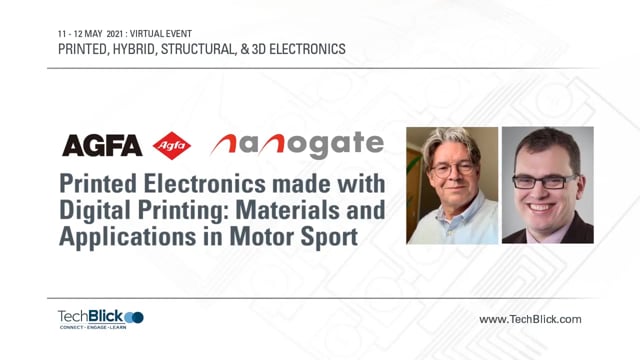
Printed Electronics made with Digital Printing: Materials and Applications in Motor Sport
Speaker: Frank Louwet | Company: Agfa | Date: 11-12 May 2021 | Full Presentation Digital printing has clearly established itself for graphics printing, thanks to the advantages it offers over traditional processes like screen printing. More recently, digital printing started morphing into digital manufacturing and also Printed Electronics is taking advantage of that evolution. In this talk we will review Agfa's digital conductive inks based on nanomaterials, and highlight some features of newly developed inks. In the second part of the talk, Nanogate Netherlands will discuss the application of additive digital manufacturing in motor sport products. Peter Willaert Global Marketing Manager Printed Electronics @ Agfa Bio Experienced Product Marketing and Business Development Manager in Printed Electronics with a background in Electronic Engineering. Over the years I have developed a broad knowledge about materials and processes for applications like RFID, iOT, Sensors, Displays etc. Join TechBlick on an annual pass to join all live online conference or online version of onsite conference access library of on-demand talks (600 talks + PDFs) portfolio of expert led masterclass year-round platform https://www.techblick.com/ And do NOT miss our flagship event in Berlin on 17-18 OCT 2023 focused on Reshaping the Future of Electronics. This event attracts 550-600 participants from all the world and offers a superb ambience and dynamic exhibition floor. To learn more visit https://ww...