


20 October 2023
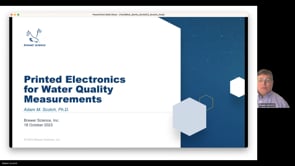
Printed Electronics for Air and Water Quality Measurements | Brewer Science
Brewer Science's vision is to design, build, and deploy connected gas and water sensors that monitor environmental contaminants quantitatively on a large scale. For the last 10 years, Brewer Science has developed the technology to print cost-effective sensors that can measure contaminants in water, such as heavy metals (lead, cadmium), copper, nitrate, pH, and ORP, as well as sensors that assess air quality by measuring gases like carbon monoxide, carbon dioxide, hydrogen, VOCs, and oxygen. Brewer Science fabricates a variety of printable sensor materials and deposits them onto a substrate utilizing processes such as physical vapor deposition (PVD) sputtering, screen printing, stencil printing, ink-jet printing, and high-speed jet dispensing. Producing low-cost sensors with low-power electronics and wireless communication will enable the deployment of sensors over vast areas for real-time monitoring of environmental conditions. SAVE THE DATE...

18 October 2023
"C.L.A.D. - Continuous Laser-Assisted Deposition of Standard MaterialsManufacturing Sustainability
IoTech is introducing a new and patented digital additive manufacturing technology: the Continuous Laser-Assisted Deposition or CLAD. CLAD is a breakthrough multi-material production process for electronics, from semiconductor packaging to flexible electronics. CLAD enables the fast, precise, high-resolution, and high-volume deposition of most industrial materials, no reformulation required. Manufacturers can - use their standard industrial materials, - control the deposition of every single drop, - print at up to 30µm resolution and, - reach unmatched production yields. The system is fast, contactless, high-resolution and micron-accurate. It enhances manufacturing flexibility for advanced electronic designs. CLAD enables more compact, powerful product functionalities in a wide range of applications. It is compatible with most conductive and dielectric fluids, even of high viscosity. CLAD is also ESG-compliant and labour-efficient. It provides an alternative to highly polluting subtractive technologies, enabling the re-shoring of production processes to OECD countries SAVE THE DATE...
16 October 2023
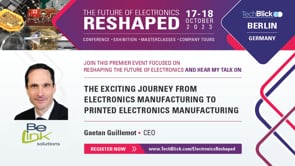
The exciting journey from electronics manufacturing to printed electronics manufacturing |Belink
Speaker: Gaetan Guillemot Company: BeLink Solutions Unless you're a printed electronics expert, you probably have no idea what's going on in the making of new innovations in printed electronics, let alone what it takes to bring technology to mass production. As the automotive, industrial, home automation, medical, aerospace and defense market segments increasingly rely on recent advances in printed electronics, it is more important than ever to establish robust manufacturing processes that provide reliability and quality to this next-generation electronics with the integration of all types of electronic components. This presentation will allow you to understand how BeLink Solutions overcame these challenges from POC to mass production. SAVE THE DATE...
13 October 2023
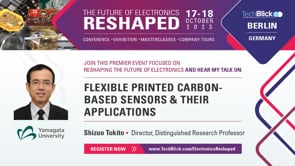
Flexible Printed Carbon-based Sensors and Their Applications | Yamagata
Our research group at Yamagata University in Japan is actively developing flexible and printed organic electronics, covering all related technologies from materials and devices to fabrication processes and applications. Our focus is on wireless applications for healthcare, robotics, and logistics. We have recently developed highly sensitive and reliable pressure, strain, and humidity sensors using composite materials of carbon and polymeric materials with simple printing methods. The pressure sensor exhibited a high resistivity change with a sensitivity of 0.014kPa-1 when pressure was applied. The stretchable strain sensors demonstrated high sensitivity with a gauge factor of approximately 14 and could stretch up to 100% with small hysteresis. The developed humidity sensors exhibited a high resistive response of 120% over the relative humidity (RH) range of 30% to 90% through an absorption and desorption mechanism, with fast response and recovery times. We have used these sensors to demonstrate human pulse wave and respiration detection, as well as tactile sensing for robot grippers. In addition, we have established flexible hybrid electronics (FHE) with screen printing methods and combined these sensors with the FHE technology to realize more practical applications for the Internet of Things (IoT) society. SAVE THE DATE...
19 October 2023
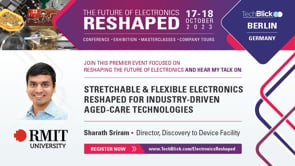
Stretchable and flexible electronics reshaped for industry-driven aged-care technologies | RMIT
The convergence of lab-based discoveries and industry-need created reimagined products based on stretchable and/or flexible substrates.Soft electronics made of silicone were translated into a printed technology to create smart bedding products to monitor aged-care residents and improve quality of care. Working closely with manufacturers, the evolution of the technology from stretchable electrodes to a sensor array across a mattress, will be covered. This approach represented a new take on production of electronic textiles.Combining flexible substrates with surface mount components, composite structures have created a category of modular sensing skin patches. Based on clinical need, different sensor combinations have been utilised for aged-care health monitoring, with potential use cases targeted to dementia care and post-operative management. SAVE THE DATE...

16 October 2023
Solution for printed micro-electronics. Next generation of resolution in additive technology | XTPL
Name:Łukasz Kosior Company: XTPL XTPL provides additive manufacturing technology and conductive materials at the micron scale to address complex issues in the advanced electronics industry. The company has developed its own solutions that allow for extremely accurate printing of functional features at the micron level with high resolution. This capability extends to both planar and non-planar complex substrates, including the ability to print continuous and highly conductive interconnections oversteps. In our presentation, we will showcase the available solutions for next-generation Flexible Hybrid Electronics, Advanced IC Packaging, and Flat Panel Display applications. Additionally, we will present our plans to introduce Ultra-Precise Deposition technology to the industry. SAVE THE DATE...

15 October 2023
Opening up new business models in Printed Electronics by leveraging advancements in roll-to-roll man
Speaker: Ashok Sridhar Company: TracXon Printed Electronics is experiencing a strong growth phase of late. To sustain this growth and to turn the hype into actual products in the market, it is necessary to come up with new business models that provide demonstrable value to companies that want to adopt Printed Electronics in their products. Such added value should go above and beyond product-related benefits such as flexibility, stretchability, conformity, etc. At TracXon, a Netherlands-based foundry for Printed Electronics, we offer unique business models that can aid broader penetration of Printed Electronics products, by lowering the barrier to entry for OEMs and Tier-1s across domains such as automotive, healthcare, IoT, consumer electronics, etc. SAVE THE DATE...
12 October 2023
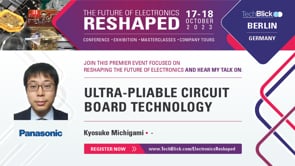
Ultra-Pliable Circuit Board Technology | Panasonic
Flexible printed circuit boards (FPCs) have found uses in a wide variety of applications, including health/wellness, mobile devices, aerospace and many more. Conventional FPCs consist of copper patterns formed on the surface of a flexible film using standard printed circuit board fabrication processes. Historically, polyimide resin (PI) has been widely used because it is readily available and possesses heat-resistant property which make it compatible with high volume assembly processes like solder reflow. However, new applications and device designs like wearables are driving the development of more conformable circuits. Stiff, high-modulus films such as polyimide are not suitable for these products and currently available pliable, low modulus films like thermoplastic polyurethane (TPU) are not compatible with surface mount assembly processes. Researchers at Panasonic Electronic Materials are developing a new material technology that overcomes the limitations of conventional FPCs. In this presentation, we will introduce our novel ultra-pliable circuit board material development. SAVE THE DATE...