



21 September 2023
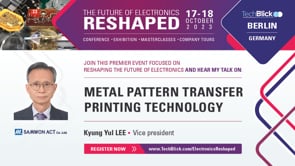
Metal Pattern Transfer Printing Technology | Swamwon ACT
Micro electronic pattern and flat cable core manufacturing process with electroforming by roll to roll equipments. This process can be applied to the development of flexible flat-cable, copper electrode of solar cell and flexible electonic components. The first advantage of this process is that relative long and wide scale metal pattern could be produced. SAVE THE DATE...

21 September 2023
INKJET PRINTED WIREBONDS FORSENSOR INTERCONNECTIONS
Author: Aart-Jan Hoeven aj.hoeven@domicro.nl | DoMicro Advanced packaging of semiconductor-based sensors brings very specific interconnection requirements. These often are related to a very narrow pitch of the interconnections or the fragility of the sensor. Different interconnection methods may also be needed because of the orientation of the sensing area or the integration of the sensor in Flexible Hybrid Electronics. DoMicro has developed an interconnection process for micro assembly of semiconductor-based sensors. This interconnection process is described as inkjet printed wire bonding. This article highlights results from recent work on an application with complex sensors. Furthermore, it includes a perspective on the competitive advantages brought by inkjet printed wirebonds. Conventional interconnection methods Figure 1. Inkjet printed wire bonds for the interconnection of microprocessor bare die Join us at TechBlick's Future of Electronics RESHAPED conference & tradeshow in Berlin on 17-18 OCT 2023 - www.techblick.com/electronicsreshaped. Contact Aart-Jan Hoeven aj.hoeven@domicro.nl | DoMicro for your discounted attendee passes Figure 1 shows a sample with interconnections made with inkjet printed wire bonding. This printing method can be considered as 2.5D printing. Depending on the sensor and integration and processing challenges, the inkjet printed wire bond interconnection method brings advantages over conventional interconnection methods. Reduced heights: Thin i...

19 September 2023
Smart Textiles: monitoring, sensing and heating technology integrated in fabrics
Authors Wim Christiaens | Quand Industries | Wim.Christiaens@quad-ind.com Textiles are tactile, sensorial and visual. Qualities can be modified or even expanded when technology is added, transforming passive textiles into active and interactive devices, monitoring and detecting bodily functions due to their constant contact with our skin. Printed electronics are also more durable than traditional electronics and can withstand multiple washing cycles, crinkling, friction and sweating. The lower production costs and easy scalability of printed electronics also stimulate the development of new (IoT) applications and a larger adoption of e-garments and smart fabrics in general, which can promote a healthier lifestyle and reduce the risk of disease, accidents and injuries in many industries. Their integration is straightforward. After printing the sensors on TPU they can be transferred onto the textile material via hot press lamination. Both are well-established techniques. Join us at TechBlick's Future of Electronics RESHAPED conference & tradeshow in Berlin on 17-18 OCT 2023 - www.techblick.com/electronicsreshaped. For special discounts on attendee passes please contact Wim.Christiaens@quad-ind.com Compared to traditional electronics manufacturing, printed electronics are easily scalable and low cost. They are durable, precise, efficient and comfortable to wear. They have excellent interconnectability. The PCB’s can be positioned in a remote spot, are small and don’t need ...

24 September 2023
Jetting Functional Fluids - Up Scaling from Laboratory to Industrial Production | Inkatronic
Speaker: Georg Boedler Company: Inkatronic Inkatronic has over 25 years’ experience in inkjet technologies, and develops specialised industrial machines for mass production. Implementing an inkjet solution to industrial processes can create incredible advantages, as well as open up new opportunities for manufacturing. However, scaling up a solution from a proven laboratory method to a mass-manufacturing environment is surprisingly difficult. In our presentation, we will give a breakdown of some of the challenges that need to be overcome in order to achieve this successfully. SAVE THE DATE...

21 September 2023
From Experiment to Final Print: Understanding Self-Regulation PTC Heaters
Thibaut Soulestin, PhD ; Lead Application Engineer at Henkel Printed Electronics; thibaut.soulestin@henkel.com Henkel Adhesive Technologies has developed a large material portfolio of conductive inks and coatings suitable for printed electronics technology. Our portfolio offers material solutions ideal for various smart surface technologies, including self-regulating foil heaters. Self- regulating foil heaters are enabled by Henkel’s Positive Temperature Coefficient (PTC) inks in combination with silver and dielectric inks. Understanding the origin of the PTC effect, typical characterizations, and basic design rules enable our customers to reveal the full potential of this technology. 1. Introduction to Henkel Positive Temperature Coefficient (PTC) carbon inks Different types of conductive polymer composites (CPC) exhibit positive temperature coefficient (PTC) properties. They have been extensively studied and some are commercially available. A vast majority is obtained by compounding a polymer binder with conductive fillers, mostly carbon-based. The increase in resistance of the conductive networks during heating is caused by the thermal expansion of the polymer and the change in the distance between the conductive fillers. The PTC effect usually occurs during the phase transition of the polymer matrix, the glass transition, or the melting. After the maximum PTC effect, if the temperature keeps rising, a negative temperature coefficient (NTC) effect can be observed due to th...

20 September 2023
Affordable Surface Lighting for Visual Interfaces through printed OLED technology | Innuru
Surface Lighting has the ability to change the world of design and change how we interact with products around us. It is a game changer for the printed electronics industry, since light and visual interfaces are becoming a part of any product. We are becoming completely depended on light as a indicator and design element, that communicates ambience, emotions, and statuses. Today Visual Interfaces have to be assembled through the hybrid electronics approach. LEDs are picked and placed and covered with light guides to achieve the target shape and form. Technologies like this maybe cheap to manufacture in mass, but they are hard to setup and to incorporate and any adjustment in shape requires additional setup costs and time. Surface lighting is paper-thin and thus has no space requirements. Affordable Surface Lighting technologies so far have been also accompanied with draw-backs of complex driving electronics, large size or lack of brightness. A technology that can meet all of this is OLED. OLED are made in process that are similar to the chip manufacturing industry. This makes them expensive in unit cost and even more in setup. Thus the dream of Light Everywhere, OLED Everywhere vanishes quickly on hard economical reality. Inuru has simplified the way OLEDs are manufactured by not taking the material into vacuum to to evaporate them, but taking the molecules and printing them. We are utilizing state of the art ink-jet technology used for color printing today. The infrastructur...

19 September 2023
Functional Fluids | Designing an Ink Delivery System for Recirculating Piezo Printheads
By Mikael Boedler, INKATRONIC GmbH | mb@inkatronic.com
Niederdorfstrasse 6, 4063 Hörsching Tel.: +43 7221 22298 In this article, we will discuss the different aspects of an effective ink delivery system. We will focus on a recirculating inkjet system as they are highly in demand in industry, especially where functional fluids come into play. Though recirculating printheads are mostly on the same price level as non-recirculating, gravity feed equivalents the ink supply system needed is much more intricate and as a result, significantly more challenging to implement (an example of a recirculating ink delivery system is shown in figure 1 below). The benefits of recirculating systems, however, are clearly outlined in the next section making it a worthy endeavour. Figure 1 - INKATRONIC Scalable Circulating Ink Supply. Advantages of Recirculating Inkjet Technology in Industry Improved Print Quality - Recirculating printheads maintain a consistent ink temperature and viscosity, resulting in more consistent droplet formation when jetting at various frequencies. This leads to a better print quality with sharper details and better lay-down accuracy. Reduced Nozzle failures - Continuous ink circulation helps prevent nozzle failures caused by ingesting air, ink drying out, or ink settling, ensuring uninterrupted printing. Faster Start-Up Times - most recirculating printheads can start printing immediately, whereas gravity-feed printheads may require cleaning cycles to recover missing noz...