


8 September 2022
Printed battery technology
Printed batteries offer thinness and flexibility, enabling new applications, but their production is deceivingly complex. Gunter Hübner from Stuttgart Media University offered some insights at the e-Swiss conference last week. The first slide shows an excellent benchmarking of different battery chemistries for printed batteries. The Zinc/manganese dioxide system is the most popular option.
As shown in slide 2, we see that these batteries can be manufactured in two architectures: coplanar and stacked. The former is simpler to print and is more flexible, but offers lower performance.
In slide 3, a closer look at the layers in a stacked printed battery is offered. As seen here, even this so-called 'simple' device involves many printing step! Since Ag is not electrochemically inert, a carbon black layer is also printed.
The particles in the anode and cathode are typically in the 10-50um range and thus can only be screen printed. Note that the cathode is typically 1.5x thicker than the anode. The printed battery layers typically have 150um thickness and the batteries achieve something in the range of 2-6mAh per cm2. Furthermore, in printing them, strong adhesion of the electrodes to the current carriers is essential.
All these show how complicated it is to print even a simple zinc/manganese battery - it involves significant know-how and learning, which can not be achieved overnight! The final slide shows an elegant clever approach to printing the system. Here, the material...

8 September 2022
Additive and high-throughput nanoscale multi-layer printing materials and devices on any substrate?
Nano-Ops is commercialising an automated wafer-based process and fab-in-a-box based on the directed assembly technology which can 'print' features down to 20nm. Here, In the first step a pattern is first etched into a template wafer. This is achieved using conventional photolithography-based techniques. Next, the template wafer is 'inked' using a directed assembly process. In the key step, the template wafer is immesed in a solution containing the nanomaterial of choice - which could, for example be metals (Au, Ag, Cu, etc) or even organic polymers. Under the application of a voltage, the directed assembly process ensures the inking of the template wafer, i.e., the deposition of the nanomaterials onto the etched patterns on the template wafers. The 'inked' wafer is then used as a printing plate. The automated machine takes the wafer and brings it into precision contact with the target substrate, which could be PET. Under pressure, contract printing takes place, transfering the ink from the inked wafer onto the final substarte. The process is then repeated to achieve high-throughput wafer-based printing. The template wafer is said to be resubale upto 100 times or more. Nano-Ops has shown that all types of materials can be deposited using various directed assembly techniques (electrophoretic and fludic). Slides one and two below shows example of different materials and patterns deposited on an patterned wafer (on the template wafer) using this technique. The feature sizes ran...
5 September 2022
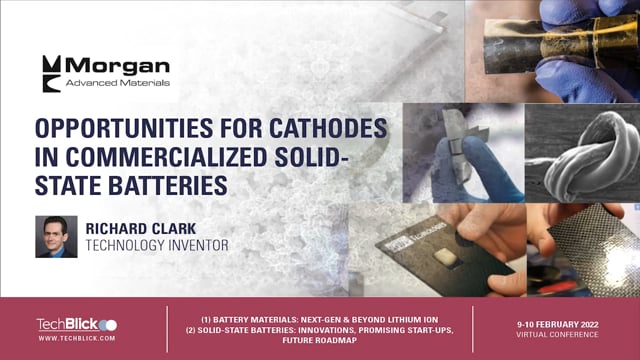
Opportunities for cathodes in commercialized solid-state batteries
Speaker: Richard Clack | Company: Morgan Advanced Materials | Date: 9-10 Feb 2022 | Full Presentation As vast investment continues to pour into the solid-state battery development arena, many automotive OEM’s are projecting Start of Production within the next five years. Although there is no clear winner for the solid-state electrolyte, room temperature lithium-ion conductivity comparable with that of the liquid carbonate incumbent has been demonstrated at the laboratory and pilot plant scales. There are multiple options for the anode, ranging from thin lithium metal to “anode-less” in-situ generation to carbon-free high-loading silicon. Most work on the cathode has been focused on supply for current lithium-ion battery configurations, without recognizing the huge opportunity the move to solid-state provides, enabling lithium-free and high voltage options as well as the possibility of step-change reductions in cost. This talk will provide an overview of current developments in cathodes and project likely winners as solid-state batteries near commercialization. Join TechBlick on an annual pass to join all live online conference or online version of onsite conference access library of on-demand talks (600 talks + PDFs) portfolio of expert led masterclass year-round platform https://www.techblick.com/ Our next battery-related event will take place on 15-16 FEB 2023, covering 1) Solid-State Batteries: Innovations, Promising Start-Ups, & Future Roadmap 2) B...

1 September 2022
EHDjetted QDs on microLEDs, R2R gravure printed perovskite PVs, 3600ppi Si displays,
Printable dielectrics for RF, Bonding in heterogeneous integration Welcome to this week edition of our technology newsletter with a focus on additive electronics. One housekeeping note: the masterclass and tour spaces taking place before our inaugural conference and exhibition in Eindhoven (Future of Electronics RESHAPED | 12-13 OCT 2022) are almost full. We are now in tocuh with venue to see if additional space can be released. We recommend that your reserve your spot ASAP. Topics for this week: EHDjet printed QDs on microLEDs | R2R single-step gravure printed perovskite photovoltaics | Gravure printed microbumps for microLEDs | 3600ppi full color "silicon" displays | Lasers in microLEDs | Printable dielectrics for RF and MW devices | Pitch scaling and bonding in heterogeneous integration | Microfluidics and Electrohydrodynamic printing | Graphene to market: breaking down regulatory barriers. High-PPI RGB microLEDs, printed electronics, and quantum dots? The three themes are closely linked since QDs can be digitally printed as color conversation materials atop blue microLEDs to enable wide color gamut RGB uLED displays without requiring a separate transfer step for each color. Join TechBlick's event on microLEDs to learn more www.TechBlick.com/microLED Inkjet is the common technology investigated for such a purpose. As shown below by Prof.Armin Wedel, however, its 4pL droplet is too large, allowing at best a 40um pixel and not able to reach even 850 dpi. Electrohydrodynami...

8 September 2022
Digital "ink-free" printing of multi metals with sub-micron precision using a single nozzle?
At the e-Swiss conference last week we came across an interesting technology showcased in a poster. Here, the process is called "Multi-metal electrohydrodynamic redox 3D printing" and developed by R. Spolenak's team at ETH Zurich Slide one shows the working principle: "Solvated metal ions Mz+ are generated within the printing nozzle via electrocorrosion of a metal electrode M0 immersed in a liquid solvent. (2) Ion-loaded solvent droplets are ejected by electrohydrodynamic forces. (3) Upon landing, Mz+ ions are reduced to zero valence metal M0 through electron transfer from the substrate." As shown the metal ions are generated in a solvent from an immersed wire thus eliminating the need for a liquid formulated ink in the deposition technique. Furthermore, as seen below, the ability to print multi materials using a single voltage-controlled nozzle enables one to adjust the chemistry and composition of the deposited materials on-the-fly, thus not only enabling layer-by-layer variation of materials but also enabling much more granular changes in composition and alloying Given that this is based on electrohydrodynamic printing- in which the droplets are injected under the application of a voltage- the feature sizes are in the sub-micron range. Slide 2 shows various examples of printed Cu structure, using the extreme control of the process as well as its excellent feature size capability This is a very promising technology with a high potential for future development. It is of cour...

6 September 2022
Toward advanced LMP® batteries : commercial generations and innovation trends
Speaker: Margaud Lecuyer | Company: BlueSolutions | Date: 9-10 Feb 2022 | Full Presentation BlueSolutions has been commercializing all-solid state batteries since 2011. EVs, buses and stationary applications are the main targets of its research and development program. After more than 15 years, this Bolloré group subsidiary masters all the industrial processes for the production of a unique solid state battery technology. The know-how goes from the transformation of the lithium ingots to the integration of the battery packs within the applications. Importantly, a low-ecological footprint process has been stated for both the positive electrode and the polymer electrolyte manufacturing. In order to get incomparable energy densities, today, all the industrial actors of lithium batteries are hardly working on the lithium metal technology. In this context, BlueSolutions has a unique 10 years feedback regarding both the behavior of this special anode and of the solid-state electrolyte. After having spread the first pack generation for 8 years all-over the world, an optimized 650V battery pack addressing the e-buses market is being delivered for one year. To match with customers expectations this new generation offers optimized performance and a very long cyclability. In the meanwhile, BlueSolutions has already started working on its future generation products. While the current battery is LFP-based and cycles at a nominal temperature of 80°C, a lot of efforts are dedicated to impro...

5 September 2022
Innovative Thermal Vias: Meeting the Power Dissipation and Thermal Management Needs
of Today’s Advanced High Performance Systems Speaker: Alfred Zinn | Company: Kuprion Inc| Date: 10-11 March 2021 | Full Presentation In today’s market, electronic systems have become ever more complex while current design methods for PCBs are limiting and inadequate. New approaches are needed to meet reliability demands for increased power dissipation and thermal management of advanced high performance systems. In this presentation, Kuprion, a spinout of Lockheed Martin, will not only detail these challenges, but demonstrate how new, innovative technologies like Active Cu (ActiveCopper™) filled thermal vias are addressing the requirements for more robust interconnect structures to enable thinner, cooler, more compact and reliable operating devices. Join TechBlick on an annual pass to join all live online conference or online version of onsite conference access library of on-demand talks (600 talks + PDFs) portfolio of expert led masterclass year-round platform https://www.techblick.com/ And do NOT miss our flagship event in Berlin on 17-18 OCT 2023 focused on Reshaping the Future of Electronics. This event attracts 550-600 participants from all the world and offers a superb ambience and dynamic exhibition floor. To learn more visit https://www.techblick.com/electronicsreshaped To see feedback about previous event see https://www.techblick.com/events-agenda...

31 August 2022
Microfluidics and Electrohydrodynamic printing (EHD)?
EHD is a promising digital printing technology for going beyond the resolution limits of inkjet. Most examples showcase electronic or display related applications.
However, in a recent TechBlick talk, as shown in slide 1, Dr Aart-Jan Hoeven showed an example in microfluidics where EHD could delvier value. Here, this technology could enable the electrode widths or pitches to be narrowed from 30-40um (possible with industrial inkjet) to perhaps 1-5um using EHD, thus saving space. This will support the miniaturization trend of microfluidics, making possible to even integrate them into the human body
In slide 2 DoMicro BV 's laboratory-scale nano printer can be seen in more detail. It is able to deposit ultrafine features digitally! This DM50-ENP printer is generating significant interest and was developed as part of E-Nanoprint-Pro project
Marcel Grooten Lars Wienholts #EHDjet #microfluidics #printedelectronics...