


24 February 2022
New technique for making wearable sensors allows faster and less costly prototyping of designs
Engineers at UC Berkeley have developed a new technique for making wearable sensors that enables medical researchers to prototype test new designs much faster and at a far lower cost than existing methods. The new technique replaces photolithography—a multistep process used to make computer chips in clean rooms—with a $200 vinyl cutter. The novel approach slashes the time to make small batches of sensors by nearly 90% while cutting costs by almost 75%, said Renxiao Xu (Ph.D.'20 ME), who developed the technique while pursuing his Ph.D. in mechanical engineering at Berkeley. "Most researchers working on medical devices have no background in photolithography," Xu said. "Our method makes it easy and inexpensive for them to change their sensor design on a computer and then send the file to the vinyl cutter to make." A description of the technique was published in ACS Nano. Xu, who now works at Apple, and Liwei Lin, professor of mechanical engineering and co-director of the Berkeley Sensor and Actuator Center, were the lead researchers. Wearable sensors are often used by researchers to gather medical data from patients over extended periods of time. They range from adhesive bandages on the skin to stretchable implants on organs, and harness sophisticated sensors to monitor health or diagnose illnesses. These devices consist of flat wires, called interconnects, as well as sensors, power sources, and antennas to communicate data to smartphone apps or other receivers. To maintai...

22 February 2022
Identiv Collaborates with NXP on NFC-Enabled Secure Sensing Tags for Product Integrity and Condition
Innovative Portfolio Powers Solutions for Anti-counterfeiting, Tamper Detection, and Batteryless Condition Sensing Identiv, Inc. (NASDAQ: INVE), a global leader in digital security and identification in the Internet of Things (IoT), today announced its portfolio of near field communication (NFC)-enabled status detection tags for advanced IoT security. Identiv’s range of NFC tags is among the first available with NXP® NTAG® Semiconductors 22x DNA chip devices, adding unique capabilities for advanced anti-counterfeiting, new-to-market tamper detection, and batteryless condition sensing. Identiv’s sophisticated NFC tag designs based on NXP’s new NTAG 22x DNA chip series enable a wide range of sensing solutions for customers in healthcare and pharma, retail, smart packaging, supply chain control (e.g., blockchain), and augmented user experiences. The cutting-edge tamper-proof portfolio secures everyday objects in mobile anti-counterfeit authentication applications and closed-loop systems, tamper proof medications, beverages, and consumables, and senses specific conditions such as moisture, pressure, or fill level powered by an NFC field, all without a battery. The sensing tags with conductive and capacitive capabilities are ideal for status-aware applications enhancing quality assurance along the supply chain, verifying fill levels for refill orders or patient compliance, and wet/dry sensing for smart wound recovery or skin patches. “Our collaboration with Identiv catalyzes...

21 February 2022
Flexible OLED for homogeneous light in the operating room
Within the joint project LAOLA (funding code: 03INT509AF), which was funded by the German Federal Ministry of Education and Research (BMBF) and has now been completed, large-area lighting applications with organic light-emitting diodes (OLEDs) on flexible substrates should be developed. The project focused on ultra-thin glass, which offers advantages compared to plastic as a substrate due to its excellent barrier properties. At the Fraunhofer Institute for Organic Electronics, Electron Beam and Plasma Technology FEP, the OLEDs were applied to the flexible glass using a roll-to-roll process. A surgical light designed using this process will be presented at LOPEC 2022, on March 23 and 24, 2022, in Munich, at the joint booth of the project coordinator Organic Electronics Saxony e.V. (OES), No. B0.308. The glare-free, homogeneous light of large-area organic light-emitting diodes (OLEDs) is perceived as very pleasant and offers many advantages for product design. In the recently completed LAOLA project, OLEDs were therefore developed as planar lighting for a wide range of applications on flexible substrates. The project focused on flexible ultra-thin glass, which offers advantages over plastic as a substrate due to its excellent barrier properties. Some of the technologies were researched as part of the internationalization project between Japan and Germany associated with LAOLA with cooperation partners from the Japanese partner cluster YUFIC at Yamagata University. ...

18 February 2022
A promising method to produce fiber batteries on an industrial scale
Fiber batteries are millimeter-thin batteries based on fibers that can be woven into items of clothing or used to create highly flexible, wearable electronics. In recent years, many research teams worldwide have been trying to fabricate these batteries, using a range of different techniques and approaches. Most existing techniques for creating fiber batteries entail layer-by-layer coating processes that were adapted from the fabrication of planar batteries, a flat and thin battery technology. Despite their advantages, these processes typically enable the creation of a limited number of batteries at a time, thus they are unsuited for large-scale production. Researchers at Fudan University in China have recently introduced an alternative method for manufacturing fiber batteries that could be easier to implement on an industrial scale. This method, introduced in a paper published in Nature Nanotechnology, is based on a general, solution-extrusion technique that can produce batches of several fiber batteries in a single step. The production method proposed by the researchers relies on a spinneret structure, a cap or plate with several small holes on it that is often used to produce fibers. This structure, which has three main extrusion channels, can be used to create fiber batteries composed of a parallel cathode and anode, encapsulated by an electrolyte, with remarkable production ra...

23 February 2022
Applying The Butterfly Principle for 3D Printing, Colour Screens
ETH Zurich researchers have created artificial colors by 3D printing certain nanostructures inspired by those of a butterfly. This principle can be used in the future to produce color screens. For their new technology, scientists in the group of Andrew deMello, Professor of Biochemical Engineering, drew inspiration from butterflies. The wings of the species Cynandra opis, native to tropical Africa, are decorated with brilliant colors. These are produced by extremely intricate regular surface structures in the size range of the wavelength of visible light. By deflecting light rays, these structures either amplify or cancel out individual color components of the light. Led by deMello, the researchers have succeeded in replicating the surface structures of Cynandra opis, as well as other modified structures, using a nano-3D printing technique. In this way, they created an easy-to-use principle for the production of structures that generate structural colors. There are numerous examples of such structural coloration in nature, including irregular surface structures – for example, found in other butterfly species. “The regular nanostructures on the wings of Cynandra opis, however, were particularly well suited to reconstruction using 3D printing,” explains Xiaobao Cao, a former doctoral student of the deMello group and lead author of this study. The Cynandra opis structures consist of two grid layers stacked perpendicular to each other, with a lattice spacing of about 1/2 to 1 mi...
22 February 2022
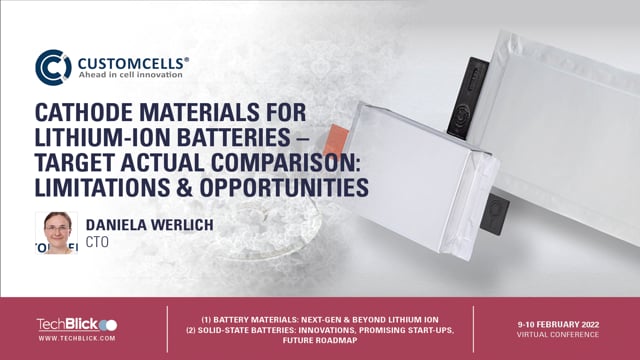
Cathode Materials For Lithium Ion Batteries – Target actual Comparison: Limitations & Opportunities
Speaker: Daniela Werlich | Company: Customcells | Date: 9-10 Feb 2022 | Full Presentation The cathode material gives a lithium-ion cell its decisive characteristics. It is therefore an important factor, especially with regard to the ever-increasing demands on energy density. We would like to show you which special parameters are important when choosing the right cathode material and we will go into the current trends and developments in this area. We will not only share information about the electrochemical characteristics but also examine challenges in processing, the cell design and the economic as well as ecologic components. Join TechBlick on an annual pass to join all live online conference or online version of onsite conference access library of on-demand talks (600 talks + PDFs) portfolio of expert led masterclass year-round platform https://www.techblick.com/ Our next battery-related event will take place on 15-16 FEB 2023, covering 1) Solid-State Batteries: Innovations, Promising Start-Ups, & Future Roadmap 2) Battery Materials: Next-Generation & Beyond Lithium Ion The speakers include: General Motors, Graphenix Development, Brookhaven National Laboratory, Fraunhofer IKTS, RWTH Aachen University, Lawrence Livermore National Laboratories, Meta Materials Inc, Skeleton Technologies, Solid State Battery Inc, Argonne National Laboratories, OneD Battery Sciences, VTT, Leyden Jar Technologies B.V., b-Science, Rho Motion, Wevo-Chemie, LiNA Energy, C...

21 February 2022
Improvement of yield and performance of OPV by using inline quality control systems
and process monitoring Speaker: Thomas Kolbusch | Company: COATEMA Coating Machinery GmbH| Date: 11-12 May 2021 | Full Presentation Coatema delivered a pilot line in 2012 to the University of Thessaloniki in Greece. (Auth). Since them there had been a continuous scale up of the system with the integration of different quality control systems like inline spectroscopy and others. In a new European project called Real Nano additional quality control systems are being installed. The talk describes the used systems, the influence of the different parameters like coating, drying, tension control and others. Thomas Kolbusch Vice President @ Coatema® Coating Machinery GmbH Bio Thomas Kolbusch is Vice President of Coatema Coating Machinery GmbH, an equipment manufacturing company for coating, printing and laminating solutions located in Dormagen, Germany. He is member of the board of the OE-A (Organic Electronic Association) in Germany, a global association for printed electronics. He serves in the advisory board of Fraunhofer ITA institute. He served as member of the board of COPT.NRW, a local association in Germany, as well as exhibition chair of the LOPEC in Munich for five years. Thomas is active in the field of fuel cells, batteries, printed electronics, photovoltaics and medical applications. He organizes the international Coatema Coating Symposium for over 19 years and represents Coatema in a number of public funded German and European projects. Thomas Kolbusch studied Business...

17 February 2022
Brilliant Matters & Nano-C dvelop ink combining p-type polymer and n-type nanocarbon semicon
Québec City, Québec, Canada and Westwood, MA, USA - Brilliant Matters and Nano-C are pleased to announce they signed a Memorandum of Understanding (MOU) to pursue the development of advanced materials for high-performance and cost-effective printed organic solar cells and photodetectors. These technologies are part of a new wave of electronic and energy-production devices that are mainly made of plastics and contain no toxic materials or rare earths. As the integration of electronic components in everyday objects is on the rise, these technologies could offer enormous environmental benefits, being far less impactful when produced, and at the end of the product’s life. Both companies have collaborated in the past and offer complementary solutions and technologies that can work together to achieve their cost and performance targets, with Brilliant Matters producing high performance p-type polymers and Nano-C making unique n-type semiconducting carbon materials. When combined, these novel semiconducting materials create a photoactive layer that can convert light into electricity efficiently. And, a key benefit is that unlike commercially available technologies, both semiconductors are deposited simultaneously from a single ink solution and require no further doping. Brilliant Matters’ CEO, Jean-Rémi Pouliot states “we are very excited to be collaborating with Nano-C on next generation products in organic printed electronics. I truly believe with our combined expertise we will be...