


22 August 2022
Automated IMSE Mass Production
Speaker: Annika Müller | Company: Arburg| Date: 10-11 March 2021 | Full Presentation Nowadays, finishing and functionalisation of the surface of high-quality plastic parts is a crucial topic and has a big influence on the industry. To achieve this in a economically efficient and standardised manner, it is important to combine all the necessary steps in the perfect way. In this presentation, we will have a look at each of these steps and how they are connected in a fully-automated production cell. In the end, the plastic part is made out of a printed and functionalized foil – ready to use. Video https://www.youtube.com/watch?v=azzLwrlO4vU Join TechBlick on an annual pass to join all live online conference or online version of onsite conference access library of on-demand talks (600 talks + PDFs) portfolio of expert led masterclass year-round platform https://www.techblick.com/ And do NOT miss our flagship event in Berlin on 17-18 OCT 2023 focused on Reshaping the Future of Electronics. This event attracts 550-600 participants from all the world and offers a superb ambience and dynamic exhibition floor. To learn more visit https://www.techblick.com/electronicsreshaped To see feedback about previous event see https://www.techblick.com/events-agenda...

19 August 2022
Stable RoHS-compliant Cd-free QDs for microLEDs?
This technology is required to simplify the manufacturing of microLEDs- this way one need not transfer R G B uLEDs but can only transfer the already efficient blue uLEDs and achieve RGB color via red and green QD color conversation. There are of course multiple material challenges including achieving Cd-free RoHS-compliant green and red QDs with (1) high enough thermal and light stability for direct integration into microLED chips/dies, (2) high blue absorbance even at low thicknesses to prevent blue color leakage, (3) narrow FWHM and high QY, (4) low self excitation, etc
QustomDot -spin off from Zeger Hens group at Ghent University- is making excellent progress in this field. They have a novel high-controlled synthesis process for InP based QDs. Last year, at TechBlick they shared some interesting stability data for QD integration in macro and thin film LEDs. These results are shown in the slides below. They show a clear pathway towards development of QDs for direct on-uLED integration
The 500um thick QD level integrated on a macro LED shows >>300hours stability even under 1W/cm2, and a 100-150um QD thin film under 130mW/cm2 also shows >>1500 hours photostability in insert conditions
These are results from last year. To hear the latest developments from QustomDot on QD-on-microLED please join TechBlick's microLED and QD event. Check the world-class agenda at www.TechBlick.com/microLEDs #microLED#miniLED#quantumdot#LED#displays#displaytechnology#RoHS#...

19 August 2022
Printed rechargeable batteries for the IoT
Introduction The Internet of things (IoT) relies on continuous data collection from a network of sensors over time. Whilst some sensors can be wired, some must be remote from a power network and should be able gather and transmit their data wirelessly. These wireless sensors need a reliable power source able to remain operational for extended periods of time, ideally for several years. Such a power source must be low-cost, compact, and able to fit into the form factor of the sensor. Power sources for thin wireless IoT sensors are typically based on bulky and non-rechargeable batteries or energy harvesting systems relying on intermittent energy sources such as light, pressure variation, or temperature variation. Rechargeable batteries combined with such an energy harvester would be very appealing in this context to compensate both the discharge of the battery over time and the irregular nature of the energy harvester. Printed batteries offer several advantages including mechanical flexibility, compact dimensions, and low production costs. In the past, several companies have been producing and selling printed batteries, but no rechargeable printed battery solution has been commercialized until now. In this article, we present a novel printed battery solution that directly addresses this challenge. We will discuss its structure, function, specifications, and the multiple possible applications we foresee for rechargeable printed batteries. Printed batteries Printed electronics is...

18 August 2022
Why can microLED technology can help narrow the energy gap in electronic devices?
Why can microLED technology can help narrow the energy gap in electronic devices? @Khaled Ahmed from Intel Corporation offered a data-rich unique assessment at TechBlick's display event in 2021. The first slide shows the battery gap- Ahmed has collected data by year showing that power demand of phones far exceeds the power supply level of batteries, creating a "battery gap" which widens each year as more power-hungry features are added whilst battery technologies imporves only incrementally. Some 70% of power consumption of a mobile phone or tablet is by the display, showing its outsize importance in shrinking this gap. The second slide shows the improvements in the efficiency (lm/W) of 'released' OLED devices per year. The OLED efficiency has clearly plateaued in produced or released products. The backdot represents the projected potential of microLEDs, showing how the microLED technology can be a game changer. The third slide shows that there is a gap between EQE of laboratory OLEDs and that of released products. The origins are not clear but likely involve trade-offs neccessary in production and trade-offs between lifetime stability and EQE. The four side compares the efficiency of GaNw LEDs at various wavelenghts vs organic LEDs (from previous slides). It shows that GaN LEDs offer dramatically higher EQE levels compared to OLEDs at all wavelenghts except red. Indeed, there is a red efficiency gap in GaN microLED technology, the filling of which is the subject of intens...
19 August 2022
Scale up Cu nanoparticle to drive down cost of production
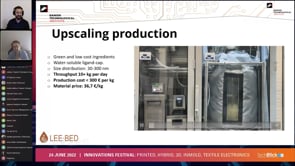
Will copper nanoparticle inks finally come of age to disrupt the dominance of silver in the conductive paste business? Cost of production has been a major barrier despite the fact that Cu raw material prices are far lower than Ag. This is because this large raw material cost difference does not often get translated into equally large nanoparticle dispersion or ink costs. To overcome this issue, Zachary James Davis et al at Teknologisk Institut have scaled up copper nanoparticle production with particle sizes between 30-300nm. As can be seen below, they have already achieved the following: 1) 10+ Kg per day - here the main bottleneck is the heating and mixing of the green ingredients 2) 300 Euros per Kg cost of production which is comparable to cost of production of Ag nanoparticles. This level of production cost- coupled with much lower raw material cost @36.7 Euro/Kg - can translate into a much lower product cost 3) Inkjet printable inks with DGME based solvents able to lay down 0.5-1um thick layers in a single pass achieving 60mOhm per sqr 4) screen printable versions (in development) targeting 50 mOhm/sqr The scale up of Cu nanoparticle production with automated workflows is an important step towards making Cu ink and paste technology a commercially viable alternative to the dominant Ag inks and pastes #printedelectronics #copper #conductiveinks #nanoparticle TechBlick Torsten Lund-Olesen Anna Krzyzanowska Kasper Vestentoft Christian Rein...

19 August 2022
What are micro-, mini-, and traditional LEDs?
Eric Virey - super analyst in the field Yole Group - prepared the below chart, showing the difference between each. Traditional LEDs come in SMD or through-hole packages and the dies are typically 1mm or larger. This well-established application finds use in general lighting, automotive lighting, and LCD backlights.
Min-LEDs are typically smaller than 200um in die size but larger than 50um, and come in SMD or CoB (chip-on-board) packages. They are currently commercial and find applications in LCD and keyboard backlights, narrow-pixel pitch LED direct view LEDs, and other sectors. In the LCD sector, they are suited to provide local dimining to imrpove contrast, making LCDs more like OLEDs on this feature.
and micro-LEDs are very small, typically smaller than 50um. The size of the microLEDs is expected to shrink furter as the technology progress to reduce LED cost (more LEDs per wafer) and transfer cost/time (more LEDs transfered within the same stamp).
Evidently each class of LEDs is very different in every sense from growth techniques to performance to application. Join TechBlick's microLED event to hear Eric and 30 other top-class speakers covering every aspects of microLED industry www.TechBlick.com/microLEDs...

18 August 2022
What are the latest status of QD-LED technology and Cd-free QD materials?
Fraunhofer-Institut für Angewandte Polymerforschung IAP is a leading research group in the field, always pushing forward the performance boundries of QD technology. As shown below, Armin Wedel shares some updates in his May 2021 TechBlick presentation. Here are some key points: 1) Cd-free QD materials: slide one shows optimized results for QY, FWHM, and PL of blue, green, and red QDs based on Cd-free chemistries. The B, G, and R QDs consist of ZnTeSe/ZnSe/ZnS, InZnP, GaP/ZnSe/ZnS, and InZnP/ZnSe/ZnS core-shell structures, enabling one to approach BT.2020 standards in a non-emissive display. These are very innovative chemistries and core-shell structures: The Te doping in ZnSe core enables very saturated blue colors with high QY (92%); the GaP shell and controlled heating enables the narrowing of the usually wide FWHM of InP-based QDs to 41nm; and the application sodium oleate during core synthesis of R QDs enables even narrower FWHM
2) QDs as color conversation in microLEDs: Slide two shows that CdSe and InP QDs can be used as color converters in microLEDs, whilst slide three shows QDs can be stable in a matrix system for uLEDs. QD color conversion is very promising for
3) Emissive QD-LEDs: OLED max luminance and EQE still beat that of emissive QD-LEDs which are far less mature. CdSe have improved over the years, offering excellent performance, but Cd toxicity is a concern. The performance of InP QD-LEDs lags far behind in terms of Cd/m2, EQE, and lifetime.
This is ...

17 August 2022
Ynvisible | How to Power Ynvisible's E-Paper Displays with NFC Energy Harvesting
Author: Philip Holgersson (Head of Product) - philip.holgersson@ynvisible.com Ynvisible’s printed E-Paper displays enable a new range of battery-less products. Why? Ynvisible’s E-Paper displays are extremely low power. Low enough to harvest energy from wireless communication interfaces such as NFC. In this article, we’ll provide a practical implementation guide on how NFC can be used to power Ynvisible’s E-Paper displays. Quick Facts About Ynvisible's E-Paper Displays As already mentioned, Ynvisible's printed e-paper displays are ultra-low power. The recommended driving voltage is ±1.5V and one square centimeter active display area requires approximately 1 mJ to activate. This translates to roughly 1-2 µW/cm2 for an always-on display. The displays also have an image memory (or image retention), which is an important parameter for battery-less applications. Ynvisible's standard displays have an image retention time of approximately 5 minutes to 15 minutes. After this period the contrast start to fade and, depending on the use case, a small refresh pulse is required to maintain full contrast. The displays are manufactured using roll-to-roll screen-printing and lamination processes. They are non-toxic, ITO-free, and mainly comprised of PET plastic. The plastic substrate and roll-to-roll production means thin, flexible, scalable, and highly cost-effective displays. Get started using Ynvisible's e-paper display kit. What is NFC? NFC (an acronym for Near Field Communications) a com...