Search Results
Search this site
1084 results found with an empty search
- Flexible Hybrid Electronics Applications for the Industrial World
Speaker: Nancy Stoffel | Company: GE Research | Date:10-11 March 2021 | Full Presentation This presentation overviews GE’s vision of the digital industrial challenges in manufacturing. It does this in the context of opportunities for sensors, and communication elements made using flexible hybrid electronics, for smart manufacturing, structural health monitoring, and for improved worker safety and productivity. Nancy Stoffel Platform Leader for FHE @ GE Research Bio Nancy Stoffel specializes in design and manufacturing of printed embedded systems and electronics packaging. She serves as GE’s representative on the Nextflex consortia Board of Governors and was recognized for her technical contributions by being named a Next Flex Fellow. Nancy holds a PhD in Materials Science from Cornell University. Her career has focused on materials and process development for electronics integration. During her 30+ industry career, she was Director of Microsystems Integration at STC MEMS & Technical Manager at Xerox Corp in-charge of inkjet device fluidic design, materials technology and process development for next generation product. During her time at IBM she developed new materials and process technology to create co-fired glass-ceramic multichip modules. She has been with GE Research for 9 years where her work has focused on the integration of sensors and electronics for power electronics, wearables and asset monitoring. She is active in the IEEE, and is the 2021 General Chair of the IEEE ECTC, the premier electronics packaging conference. Join TechBlick on an annual pass to join all live online conference or online version of onsite conference access library of on-demand talks (600 talks + PDFs) portfolio of expert led masterclass year-round platform https://www.techblick.com/ And do NOT miss our flagship event in Berlin on 17-18 OCT 2023 focused on Reshaping the Future of Electronics. This event attracts 550-600 participants from all the world and offers a superb ambience and dynamic exhibition floor. To learn more visit https://www.techblick.com/electronicsreshaped To see feedback about previous event see https://www.techblick.com/events-agenda
- Thin-Film Solid-State Batteries - All Dry Multi-Stack Microbatteries
Thin-Film Solid-State Batteries - sometimes known as “Microbatteries” - can power wireless sensors, smart cards, active RFID tags, and microelectronics as SMT components. This is an active area of research with tremendous potential for future advancements. Group for Thin-Film Batteries @Empa led by @Yaroslav Romanyuk (https://www.empa.ch/web/s207/thin-film-batteries) is exploiting the 2D thin-film geometry to discover novel materials and investigate interface phenomena, paving the way for the next generation of solid-state batteries. Here, we offer a sneak peek, including a unique patent-pending monolithic multi-cell solid-state battery manufactured using all-dry vacuum processes offering rapid charge/discharge. Here the calculated performance of a monolithic multi-cell battery is shown on a Ragone plot, showing it can potentially outperform Li-ion batteries in terms of power density (W/Kg), offering a rapid charge in less than a minute. The latest results and developments will be presented at TechBlick’s event on (1) Solid-State Batteries and (b) Solid-State Battery Materials on 15-16 Feb 2023 online. https://www.techblick.com/event/batterymaterials. ✔️ Slide 1: Fabrication line for all-vacuum thin-film solid-state batteries. Manufacturing methods include various physical vapor deposition (PVD) processes, such as magnetron sputtering and thermal evaporation. The manufacturing chambers are connected to argon-filled gloveboxes for in-situ transfer. Atomic layer deposition (ALD) is used to deposit conformal interlayers and coatings, and flash-lamp annealing (FLA) is suitable for the rapid crystallization of individual layers. ✔️ Slide 2: Recent research highlights of our group at Empa include stable multi-electron cycling of Li-rich NMC811 thin-film cathodes within a wide voltage range [1], ultra-thin amorphous LLZO insulating coatings to block lithium dendrites [2], amorphous carbon interlayers at the Cu/LiPON interface to facilitate homogeneous Li plating and stripping in an anode-free configuration [3], and flash-lamp annealing of layered oxide cathodes that enable flexible aluminum foils as conductive substrates [4]. ✔️ Slide 3: Sequential deposition of individual thin-film cells using all-dry vacuum methods results in a monolithic stack, which can increase the capacity of the individual cell while maintaining the advantages of thin-film geometry, such as fast charging and discharging and a long lifetime ✔️ Slide 4: Calculations showing that the monolithically-stacked multi-cell battery can achieve power performance comparable to supercapacitors combined with high energy densities, enabling new applications demanding safe, high-power sources with easy thermal management. These results and much more will be presented at TechBlick’s event on (a) Frontier Battery Materials and (b) Solid-State Battery Materials on 15-16 Feb 2023 online. This is a world-class agenda - please check out the agenda and sign up now https://www.techblick.com/event/batterymaterials Speakers include General Motors, Sila Nanotechnologies, Li Metal, Skeleton Technologies, Solid State Battery, Leyden Jar Technologies B.V., Graphenix Development, Brookhaven National Laboratory, Fraunhofer IKTS, RWTH Aachen University, Lawrence Livermore National Laboratories, Meta Materials Inc, Argonne National Laboratories, OneD Battery Sciences, VTT, b-Science, Rho Motion, Wevo-Chemie, LiNA Energy, CNM Technologies, Ionblox, Empa, Zinc8 Energy Solutions, Avicenne Energy, Echiontech, South8 Technologies, Basquevolt, NanoXplore, Chasm, & Fraunhofer ISI [1] A. Aribia, J. Sastre, X. Chen, M.H. Futscher, M. Rumpel, A. Priebe, M. Döbeli, N. Osenciat, A.N. Tiwari, Y.E. Romanyuk, "Unlocking Stable Multi-Electron Cycling in NMC811 Thin-Films between 1.5 – 4.7 V", Adv. Energy Mater. 2022, 2201750.https://doi.org/10.1002/aenm.202201750 [2] J. Sastre, M.H. Futscher, L. Pompizi, A. Aribia, A. Priebe, J. Overbeck, M. Stiefel, A.N. Tiwari, Y.E. Romanyuk, "Blocking Lithium Dendrite Growth in Solid-State Batteries with an Ultrathin Amorphous Li-La-Zr-O Solid Electrolyte", Comm. Mater. 2021, 2, 76.https://doi.org/10.1038/s43246-021-00177-4 [3] M.H. Futscher, T. Amelal, J. Sastre, A. Müller, J. Patidar, A. Aribia, K. Thorwarth, S. Siol, Y.E. Romanyuk, "Influence of Amorphous Carbon Interlayers on Nucleation and Early Growth of Lithium Metal at the Current Collector-Solid Electrolyte Interface", J. Mater. Chem. A 2022, 10, 15535.https://doi.org/10.1039/D2TA02843C [4] X. Chen, J. Sastre, A. Aribia, E. Gilshtein, Y.E. Romanyuk, "Flash Lamp Annealing Enables Thin-Film Solid-State Batteries on Aluminum Foil", ACS Appl. Energy Mater. 2021, 4, 5408. https://doi.org/10.1021/acsaem.1c01283
- Developing electrolytes for next-gen batteries under ultra low temperature and high voltage conditi
Electrolytes hold the key for enabling various battery chemistries including solid state batteries. Currently, the electrolyte based on using LiPF6 as salt and ethylene carbonate/dimethyl carbonate as solvents have been very successful for applications under normal conditions. However, extreme conditions can arise from using batteries during very cold weather or increasing the charge voltage limit to increase overall energy density. Conventional electrolytes fail under these conditions because they cannot support effective lithium ion transport across the electrolyte and the interphase. @Enyaun Hu et at @Brookhaven National Laboratory has been working on developing novel electrolytes for extreme conditions by engineering the solvent and the electrolyte additives. In the following slides we give us a sneak peak view of the latest two insights obtained by taking advantage of the local synchrotron facility, which enables to characterize the electrolyte and the interphase with techniques that are beyond the reach of lab-based tools. Much more will be presented at TechBlick’s event on (a) Frontier Battery Materials and (b) Solid-State Battery Materials on 15-16 Feb 2023 online. https://www.techblick.com/event/batterymaterials In particular, it will be shown how ✔️ isoxazole-based electrolytes in Li | SPAN batteries can improve performance at ultra low temperatures (e.g., -30C) despite having lower bulk conductivity. Here, the origins are studies using XAS and XRF imaging, attributing it to interphase properties ✔️ 1-2% of additives to commercial LiPO2F2 electrolyte can enable high voltage performance, even under 4.8V. This is important, for example, in enabling nickel-rich layered cathode materials to be used in SSBs with Li metal anodes. These are important developments which further the art, enabling high performance solid state batteries with, for example, Li metal anodes and Ni-rich layered cathodes, to also perform well in extreme temperature and bias voltage conditions. Much more will be presented at TechBlick’s event on (a) Frontier Battery Materials and (b) Solid-State Battery Materials on 15-16 Feb 2023 online. https://www.techblick.com/event/batterymaterials
- 2D R2R carbon nanomembranes to suppress dendrite growth in solid state batteries
Solid-State-Batteries with metal (e.g., Li) anodes have the potential to dramatically increase the energy density of batteries beyond what standard Li-ion batteries can do. In electric vehicles, this could boost driving range to 700-800Km! A well-known technology challenge is excessive dendrite growth, shortening cell lifespan and perhaps even compromising safety by causing short circuits. In this post, @Albert Schneiders from @CNM Technologies offers a potential solution based on R2R-manufactured 2-dimensional insulating carbon nano-membranes. All the details will be presented at TechBlick’s event on (a) Frontier Battery Materials and (b) Solid-State Battery Materials on 15-16 Feb 2023 online. https://www.techblick.com/event/solidstatebatteries ✔️ Helium ion microscopy image of freestanding CNMs over a copper grid. These materials are insulating and are shown to conduct Li ions. They have potential to be manufactured at scale using R2R processes ✔️ Measurement data showing that the insertion of a 2D carbon nanomembrane can double the lifetime of a symmetric Li coin cell!! This technology could be applied to: ▶️ Liquid electrolyte/quasi solid state electrolytes as a functional layer over a conventional separator facing metal anode ▶️ Solid state electrolytes over ceramic solid state electrolytes to improve the ionic conductivity at the interface ▶️ Artificial SEI as an artificial solid electrolyte interface on Cu electrode enabling anodeless metal batteries These results and much more will be presented at TechBlick’s event on (a) Frontier Battery Materials and (b) Solid-State Battery Materials on 15-16 Feb 2023 online. This is a world-class agenda - please check-out the agenda and sign up now https://www.techblick.com/event/solidstatebatteries Speakers include General Motors, Sila Nanotechnologies, Li Metal, Skeleton Technologies, Solid State Battery, Leyden Jar Technologies B.V., Graphenix Development, Brookhaven National Laboratory, Fraunhofer IKTS, RWTH Aachen University, Lawrence Livermore National Laboratories, Meta Materials Inc, Argonne National Laboratories, OneD Battery Sciences, VTT, b-Science, Rho Motion, Wevo-Chemie, LiNA Energy, CNM Technologies, Ionblox, Empa, Zinc8 Energy Solutions, Avicenne Energy, Echiontech, South8 Technologies, Basquevolt, NanoXplore, Chasm, & Fraunhofer ISI
- Specialized resins enabling automated stacking of redox flow batteries
Redox Flow Batteries (RFBs) will play in important role in the future of energy storage system. A key advantage of RFBs is that they can be connected in series to form a stack. However, this process, if it is to be implemented at scale, requires automation. Interestingly, it is often highly specialized adhesives and potting materials which are in the unsung heros enabling this automation in harsh and highly oxidising environments. In this post, @Andreas Artl at @Wevo Chemie offers a sneek-peak view on the following. Much more will be presented at TechBlick’s event on (a) Frontier Battery Materials and (b) Solid-State Battery Materials on 15-16 Feb 2023 online. https://www.techblick.com/event/batterymaterials ✔️ The constructions of redox flow batteries and material challenges in stack assembly of RFBs especially in the presence of a harsh vanadium electrolyte ✔️ the need for adhesive and potting materials in helping ‘automate’ the process of stacking, which could otherwise be manual based on use of threaded rods or clamping rings ✔️ some sneek-peak results showcasing results of how polyurethane, epoxy and silicone resins survive in vanadium electrolytes at different oxidizing potentials ✔️ some sneek-peak results showing flame-resistance, thermal properties, and hydrogen permeation for fuel cells. These results and much more will be presented at TechBlick’s event on (a) Frontier Battery Materials and (b) Solid-State Battery Materials on 15-16 Feb 2023 online. This is a world-class agenda - please check-out the agenda and sign up now https://www.techblick.com/event/batterymaterials Speakers include General Motors, Sila Nanotechnologies, Li Metal, Skeleton Technologies, Solid State Battery, Leyden Jar Technologies B.V., Graphenix Development, Brookhaven National Laboratory, Fraunhofer IKTS, RWTH Aachen University, Lawrence Livermore National Laboratories, Meta Materials Inc, Argonne National Laboratories, OneD Battery Sciences, VTT, b-Science, Rho Motion, Wevo-Chemie, LiNA Energy, CNM Technologies, Ionblox, Empa, Zinc8 Energy Solutions, Avicenne Energy, Echiontech, South8 Technologies, Basquevolt, NanoXplore, Chasm, & Fraunhofer ISI
- Development status and roadmap for niobium-based anode materials
Dr Alex S Groombridge, Co-founder & CTO Echion is a leading battery materials company providing advanced technology to solve some of the biggest electrification and decarbonisation challenges for industrial users. We specialise in the development and supply of lithium-ion anode active materials based on niobium, at Gigawatt-hour (>1,000 T/y) scale. These materials enable Li-ion batteries to improve safety, charge in less than 10 minutes, and last for more than 10,000 full charge/discharge cycles, without changing manufacturing methods. Improving the Li-ion battery Current lithium-ion batteries have performance limitations, especially for applications where high power, long cycle life and safety are key requirements. The technology that works for passenger electric vehicles will not work as well for industrial or commercial applications, where expensive capital assets need to return a low Total Cost of Ownership over a long lifetime. What are the limitations of other anode materials? Current anode materials (particularly graphite, Si-based, LTO) all bring a level of compromise and limitation for these applications. For graphite, there are limitations in safety, fast-charging, and lifetime, particularly related to Li ‘plating’ and electrolyte side reactions. Silicon-based materials show leading energy densities but have limitations in lifetime and fast-charging relating to their large volume expansion. LTO, while able to fast charge safely with a long lifetime, has limitations in its low energy density that prevents use in most industrial applications. A solution that balances out these needs and delivers a higher performing battery to market requirements is needed. A differentiated solution for heavy-duty applications Echion’s Mixed Niobium Oxide (XNO®) materials enable uniquely high operational efficiencies and record low total cost of ownership, which enables end users to sustainably electrify heavy-duty transport and industrial applications. Whilst these markets are considered niche in the global battery field including passenger car electrification, alone they represent an untapped ~100 GWh opportunity. These include rail, high-power off-road vehicles, high-utilisation fleets of trucks, buses, or delivery vans, mining equipment, high-performance hybrids, motorsports, and many more applications requiring outstanding performance. How does XNO® perform? The graph shows (in the green shaded area) how XNO® outperforms both graphite (grey) and LTO (blue) commercial cells in the key metrics of fast charging and energy density. It also delivers exceptional cycle life and a safer operation. In the talk, we will dive into some of the details behind this performance, from fundamental through to large format cell updates – including our latest tables 4690 cylindrical cells. Material available at scale now A key ingredient to Echion’s XNO® anode material is an element called niobium (Nb). It is neither rare, nor expensive, and is already used at 100,000+ tonnes per year scale in dozens of applications around us, including structural steel. CBMM, the world’s largest producer of niobium, is a minority shareholder of Echion, and a strategic partner. They operate state-of-the-art mining and refining facilities in Araxá (Brazil), with stellar ESG credentials. Echion and CBMM have recently announced our manufacturing partnership, w hich enables Echion to supply large volume, high quality, sustainable XNO® materials with exceptional price stability. Our XNO® anode materials have been produced at the >10 tonne scale since 2022 and will be available at the 2,000-tonne scale by early 2024.
- New anode concepts for solid state batteries
Speaker: Susanne Doerfler| Company: Fraunhofer IWS | Date: 9-10 Feb 2022 | Full Presentation The lithium/ electrolyte interphase is still a bottleneck for efficient and reversible ionic transport in solid state batteries. In this presentation alternative anode concepts based on 100 % silicon, silicon/carbon composites and porous carbons will be introduced. All material concepts have been investigated in thiophosphate-based solid state batteries and performance data will be discussed. Join TechBlick on an annual pass to join all live online conference or online version of onsite conference access library of on-demand talks (600 talks + PDFs) portfolio of expert led masterclass year-round platform https://www.techblick.com/ Our next battery-related event will take place on 15-16 FEB 2023, covering 1) Solid-State Batteries: Innovations, Promising Start-Ups, & Future Roadmap 2) Battery Materials: Next-Generation & Beyond Lithium Ion The speakers include: General Motors, Graphenix Development, Brookhaven National Laboratory, Fraunhofer IKTS, RWTH Aachen University, Lawrence Livermore National Laboratories, Meta Materials Inc, Skeleton Technologies, Solid State Battery Inc, Argonne National Laboratories, OneD Battery Sciences, VTT, Leyden Jar Technologies B.V., b-Science, Rho Motion, Wevo-Chemie, LiNA Energy, CNM Technologies, Ionblox, Empa, Zinc8 Energy Solutions, Avicenne Energy, Echiontech, South8 Technologies, Basquevolt, NanoXplore, Chasm, Li Metal, Sila Nanotechnologies, Quantumscape (tentative), Fraunhofer ISI, etc https://www.techblick.com/
- Advances in Carbon Conductive Additives for LIB Applications
Speaker: Andriy Korchev | Company: Cabot | Date: 9-10 Feb 2022 | Full Presentation Through a broad portfolio of advanced carbons that includes carbon nanotubes (CNT), carbon black (CB), and carbon nanostructures (CNS), Cabot Corp. has brought the world leading solutions of conductive carbons for lithium ion batteries (LIBs). Cabot’s research and development team has worked to optimize the usage and function of conductive materials in LIBs. In cathodes, high aspect ratio CNTs, show clear benefits in imparting electronic conductivity at the lowest loadings across an electrode film. While, aciniform carbons, CBs, can make many contact points with lithium containing active materials for efficient ionic conductivity, as well as provide the space necessary for Li+ transport, while balancing the cost and processability challenges of CNTs. In silicon containing anodes, CNS is a new class of novel crosslinked CNT materials that greatly improve the cycle life of the cell. This has been shown through electrochemical testing of model cells. Conductive carbons continue to be a key material technology in LIB. Cabot continues to work to optimize their function in LIBs with the goal of enabling LIB makers to develop winning cell designs by pushing developments in energy density and cycle life among others. Join TechBlick on an annual pass to join all live online conference or online version of onsite conference access library of on-demand talks (600 talks + PDFs) portfolio of expert led masterclass year-round platform https://www.techblick.com/ Our next battery-related event will take place on 15-16 FEB 2023, covering 1) Solid-State Batteries: Innovations, Promising Start-Ups, & Future Roadmap 2) Battery Materials: Next-Generation & Beyond Lithium Ion The speakers include: General Motors, Graphenix Development, Brookhaven National Laboratory, Fraunhofer IKTS, RWTH Aachen University, Lawrence Livermore National Laboratories, Meta Materials Inc, Skeleton Technologies, Solid State Battery Inc, Argonne National Laboratories, OneD Battery Sciences, VTT, Leyden Jar Technologies B.V., b-Science, Rho Motion, Wevo-Chemie, LiNA Energy, CNM Technologies, Ionblox, Empa, Zinc8 Energy Solutions, Avicenne Energy, Echiontech, South8 Technologies, Basquevolt, NanoXplore, Chasm, Li Metal, Sila Nanotechnologies, Quantumscape (tentative), Fraunhofer ISI, etc https://www.techblick.com/
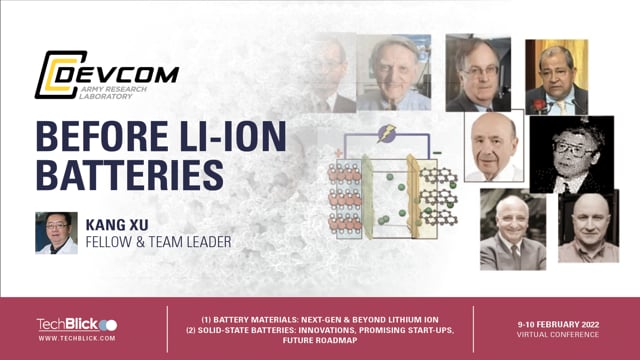
- Before Li-ion Batteries
Speaker: Kang Xu | Company: US Army Research Lab | Date: 9-10 Feb 2022 | Full Presentation Join TechBlick on an annual pass to join all live online conference or online version of onsite conference access library of on-demand talks (600 talks + PDFs) portfolio of expert led masterclass year-round platform https://www.techblick.com/ Our next battery-related event will take place on 15-16 FEB 2023, covering 1) Solid-State Batteries: Innovations, Promising Start-Ups, & Future Roadmap 2) Battery Materials: Next-Generation & Beyond Lithium Ion The speakers include: General Motors, Graphenix Development, Brookhaven National Laboratory, Fraunhofer IKTS, RWTH Aachen University, Lawrence Livermore National Laboratories, Meta Materials Inc, Skeleton Technologies, Solid State Battery Inc, Argonne National Laboratories, OneD Battery Sciences, VTT, Leyden Jar Technologies B.V., b-Science, Rho Motion, Wevo-Chemie, LiNA Energy, CNM Technologies, Ionblox, Empa, Zinc8 Energy Solutions, Avicenne Energy, Echiontech, South8 Technologies, Basquevolt, NanoXplore, Chasm, Li Metal, Sila Nanotechnologies, Quantumscape (tentative), Fraunhofer ISI, etc https://www.techblick.com/
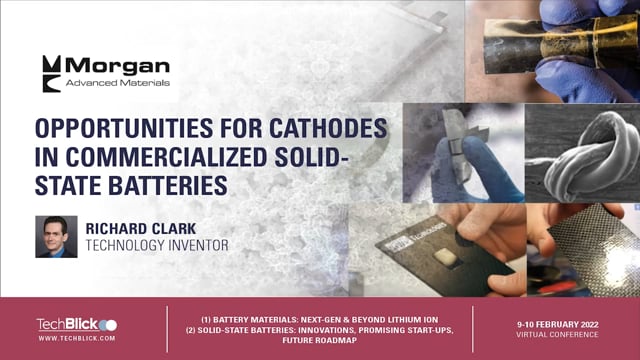
- Opportunities for cathodes in commercialized solid-state batteries
Speaker: Richard Clack | Company: Morgan Advanced Materials | Date: 9-10 Feb 2022 | Full Presentation As vast investment continues to pour into the solid-state battery development arena, many automotive OEM’s are projecting Start of Production within the next five years. Although there is no clear winner for the solid-state electrolyte, room temperature lithium-ion conductivity comparable with that of the liquid carbonate incumbent has been demonstrated at the laboratory and pilot plant scales. There are multiple options for the anode, ranging from thin lithium metal to “anode-less” in-situ generation to carbon-free high-loading silicon. Most work on the cathode has been focused on supply for current lithium-ion battery configurations, without recognizing the huge opportunity the move to solid-state provides, enabling lithium-free and high voltage options as well as the possibility of step-change reductions in cost. This talk will provide an overview of current developments in cathodes and project likely winners as solid-state batteries near commercialization. Join TechBlick on an annual pass to join all live online conference or online version of onsite conference access library of on-demand talks (600 talks + PDFs) portfolio of expert led masterclass year-round platform https://www.techblick.com/ Our next battery-related event will take place on 15-16 FEB 2023, covering 1) Solid-State Batteries: Innovations, Promising Start-Ups, & Future Roadmap 2) Battery Materials: Next-Generation & Beyond Lithium Ion The speakers include: General Motors, Graphenix Development, Brookhaven National Laboratory, Fraunhofer IKTS, RWTH Aachen University, Lawrence Livermore National Laboratories, Meta Materials Inc, Skeleton Technologies, Solid State Battery Inc, Argonne National Laboratories, OneD Battery Sciences, VTT, Leyden Jar Technologies B.V., b-Science, Rho Motion, Wevo-Chemie, LiNA Energy, CNM Technologies, Ionblox, Empa, Zinc8 Energy Solutions, Avicenne Energy, Echiontech, South8 Technologies, Basquevolt, NanoXplore, Chasm, Li Metal, Sila Nanotechnologies, Quantumscape (tentative), Fraunhofer ISI, etc https://www.techblick.com/ You can also check-out the agenda for our 2022 event here
- Murata- MXenes for electronics and printed electronics
An emerging class of two-dimensional (2-D) materials group, crystalline 2-D transition metal carbides or nitrides (MXene), has attracted considerable interest in the past decade. Murata has focused on an electrically conductive MXenes, especially for Ti3C2Tx in spray-coated film state (18000 S/cm at 5 um thickness). The hydrophilic nanosheet with outstanding properties (conductivity, high surface area and versatile surface chemistry) is a promising candidate of materials for flexible electronics using an eco-friendly manufacturing process. Swelling behavior of MXene by moisture is a roadblock for its applications in electronics. The interlayer spacing of layered structure is increased as stored in 60C/85% RH, which causes the degradation in electrical properties and the following oxidative reaction to TiO2. Murata has developed the concept of guest accommodation via hydrogen bonding to block water diffusion and demonstrated that it improves environmental stability in humid conditions. On 2 Dec, at TechBlick event on Printed Electronics Innovatipons, Shun Sakaida from Murata will present the latest developments in producing conductive Ti3C2Tx in spray-coated film state as well as in managing the moisture-induced swelling challenge. This is a step forward towrads allowing industrial use of this material in coated and/or printed applicaitons. his is an open free-to-attend event bringing together 25 presenters over two parallel live tracks, 30+ live virtual exhibitors and 400+ attendees from around the world in a unique virtual environment. You can see the full agenda and register FREE here Murata Manufacturing Co., Ltd is a leading global (Japanese) company offering a range of state-of-the-art cermaic based devices and components including MLCCs, EMI filters, SAW filters, resonators, etc going into all manner of electronic and electrical (e.g., electric vehicle) products. Slide 4 offers a glimpse into their product range.
- Printed smart labels based on green substrates combining printed OPVs, supercapacitors, SMDs, graphi
Marja Vilkman from VTT will present the latest on the theme tomorrow at TechBlick's event on Perovskite, Organic, CIGS and Tandem Photovoltaics - check out the agenda now www.TechBlick.com First slide depicts the structure of the smart label and the associated package design optimized for the best performance, functionality, and appearance. The labels were fabricated according to process flow described in the upper image. Biobased PLA and commercial fossil-PET (as a reference) films were chosen as base substrates for the labels. Silver and dielectric were screen printed for the antenna and circuitry. Organic photovoltaics (OPV) was printed next to the antenna, the supercapacitor on top of OPV and, surface mount devices (SMD) were assembled with isotropic conductive adhesive. The printed graphics film on biobased substrate covered the label. The graphics film was designed to provide the information for the user and comprised embossed feature for authentication. Second slide presents the use of energy autonomous smart label for the temperature monitoring of the secondary packaging. Intelligent packaging is a relatively new application domain, and it has specific expectations as the smart label comprising electronics would need to be cost-efficient, recyclable, and lightweight. Aim of the product design was to identify the opportunities of the intelligent product packaging using new materials and production processes to improve material and production efficiency and, product properties e.g., climate impacts, resource savings, functionalities, and usability. Join us tomorrow to learn more www.TechBlick.com