


14 June 2022
R2R: jet selective metallization for industrial level production
JetMetal Technologies has developed a novel process which is able to spray jet metallize surfaces with select area control. In this technique, two water-based components are sprayed onto a surface and via a redox process under atmospheric temperature and pressure conditions a thin layer of pure metal (in this case mainly Ag) is formed. The thickness can range from 10nm to 5um but is most typically a few hundred nanometers. This process is thus a bridge between high-throughput painting process and thin and controlled plating deposition. The formed lines are close to pure Ag, and thus offer high conductivity. Indeed, JetMetal Technologies suggests that they can reach 85-90% of bulk Ag conductivity on a smooth PET substrate when the sprayed coating is 500nm thick.
Both the thinness and high conductivity are clearly differentiated from traditional particle-based pastes and inks because such traditional inks are typically 20-30% bulk Ag conductivity when applied on low-T PET substrates. Furthermore, with the exception of inkjet or particle-free inks, the printed thickness levels are typically in the few micrometer ranges. A challenge for any spraying or jetting process is the ability to achieve selective area metallization. JetMetal has developed a hybrid process in which a dielectric ink is first printed (Screen, inkjet, gravure, etc) to act as a mask. The jet metallization then applies the Ag, metallising the exposed parts and (this is crucial) removing the masking ink at the s...

13 June 2022
Electrohydrodynamic Printing: Breaking the Limits of Inkjet
EHD is one of the most exicintg developments in the additive electronics field. It offers several key advantages over traditional inkjet: (1) it can achieve lower resolutions beyond current capabilities of inkjet, (2) can handle a wider range of ink viscosities, and (3) can cover non-flat topographies. EHD can print drops with <500nm diameters. It can reach 1-10um resolution, which standard inkjet would struggle to achieve. Furthermore, it can handle pastes with viscousities of some 1000 Cp. Given that the principle is based upon particles being pulled out by electrostatic force, whereas being pushed out by mechnical force as is the case with inkjet, the trajectory of the particles can be controlled, enabling one to print on 3D or non-flat topographies. These are all important technological steps forward. In the second slide, you can see examples of printing lines, droplets, and other patterns, demonstrated by Enjet. In the case of lines, one can see L/S ranging from 2/2um to 80/80um, demonstrating both the versality and also ultrafine line printing capabilities of this technology. In the inset, digital printing over a non-flat surface is shown, demonstraing good step coverage. A challenge for this technology is that it is slow. Most systems are R&D systems with a single head. However, companies are now developping industrial-scale mult-head printing. The embedded video shows a multi-bozzle array printing of 0.5-1um Ag NP lines by Scrona. This is a fantastic result because i...
13 June 2022
Why your next automotive heater will be a CNT hybrid
Speaker: Ken Klapproth | Company: CHASM Advanced Materials| Date: 10-11 March 2021 | Full Presentation Bio With more than 25 years of success matching technically advanced products to market demand, Mr. Klapproth has helped companies small and large achieve double-digit growth. He joined CHASM in 2019 bringing global expertise from leading sales and marketing organizations at companies including Desalitech, Elsevier, IHS, Entuity, Proficiency, and Siemens. Results-oriented and data-driven, Ken is fanatical about accelerating sales traction for technically complex products, cutting edge demand generation, is the holder of two U.S. patents, and believes electronics should be intuitive, integrated, organic, and – most importantly – NOT seen. Ken holds a BS in Mechanical Engineering from the University of Connecticut and began his professional career at Pratt & Whitney designing jet engines found under the wing on many of today’s modern aircraft including the Boeing 777. In his spare time, Ken is an avid woodworker, photography and video enthusiast, and runner. Join TechBlick on an annual pass to join all live online conference or online version of onsite conference access library of on-demand talks (600 talks + PDFs) portfolio of expert led masterclass year-round platform https://www.techblick.com/ And do NOT miss our flagship event in Berlin on 17-18 OCT 2023 focused on Reshaping the Future of Electronics. This event attracts 550-600 participants from all the world and offer...
8 June 2022
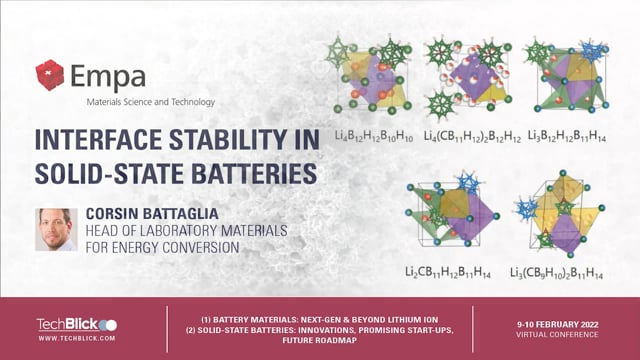
Interface Stability in Solid-State Batteries
Speaker: Corsin Battaglia | Company: EMPA | Date: 9-10 Feb 2022 | Full Presentation Solid-state batteries combining an alkali metal anode and a high-voltage cathode have the potential to double the energy density of current-generation rechargeable batteries. We recently demonstrated the integration of hydroborate solid electrolytes with a 4 V class cathode through in-situ formation of a passivating interface layer. Combined with their high ionic conductivity > 1 mS/cm at room temperature, low gravimetric density 1.2 g/cm3, low toxicity, high thermal and chemical stability, stability vs lithium and sodium metal, soft mechanical properties enabling cold pressing, compatibility with solution infiltration, and potential for low cost, hydroborate electrolytes represent a promising option for a competitive next-generation solid-state battery technology. Join TechBlick on an annual pass to join all live online conference or online version of onsite conference access library of on-demand talks (600 talks + PDFs) portfolio of expert led masterclass year-round platform https://www.techblick.com/ Our next battery-related event will take place on 15-16 FEB 2023, covering 1) Solid-State Batteries: Innovations, Promising Start-Ups, & Future Roadmap 2) Battery Materials: Next-Generation & Beyond Lithium Ion The speakers include: General Motors, Graphenix Development, Brookhaven National Laboratory, Fraunhofer IKTS, RWTH Aachen University, Lawrence Livermore Nationa...

13 June 2022
LIFT Processs: digitization of screen and stencil printing
LIFT or laser induced forward transfer is a process enabling digital non-contact deposition of highly viscous conductive pastes and even adhesives and solder. This is in contract to inkjet which digital prints low viscousity inks. The principle of operation is demonstrated in the first slide. A transparent film is coated uniformly with a thin layer of paste. When laser pulses hit a spot on the film, if the paste is correctly formulated, it will detach and land on the substrate. As such, this technique opens to way to print without mask or nozzles pattens of various viscous materials on any substrates. The second slide shows the various materials that could be printed. The table is from IO Tech, suggesting that a wide range of off-the-shelf materials can be LIFT printed. It is of course not as straighforward as this since many parameters need to optimized, e.g., laser fluence, pulse rate, distance of film to substrate, print speed, coated film thickness, shear thinning properties of the paste, target substrate, etc, etc I include some printed patterns from literature. These are printed straightlines using PV metallization pastes, showing that narrow linewidths as well as very high aspect ratios can be achieved. In one example, a linewidth of 65um is achieved. Note that this is below the state of production in screen printing of PV pastes (34um). In subsequent slides, you can see various demonstrations. In these examples, solder paste is LIFT printed, adhesives are deposited, ...
13 June 2022
Digital printing with few micron resolution on non-flat surfaces with highly viscous pastes
Digital fineline printing is one of the most important developments in additive electronics. Inkjet itself has come very far with excellent progress even towards R2R industrialization. However, inkjet has two limitations as a technology: (1) limited resolution and (2) limited ink viscosity range. Here, we highly two technologies that can overcome these limits Here we highloght the microdispensing technology developed by XTPL with nozzle diameters in the range of 0.5-12um. It demonstrates a unique combination of ultrafine line (few micron) 'digital' printing on flat and non-flat surfaces AND highly conducting (4p% Ag bulk?) highly viscous nanoparticle (Ag, Cu, Au) pastes. Thus, this technology advances the art not just by extenting the resolution of digital printing beyond what inkjet achieves but also by enabling far more conductive and highly loaded conductive pastes. The innovation here is not just the microdispensing machine, but also the unique non-Newotonian highly-loaded nanoparticle pastes. The AgNP pastes have high loading (>85 wt% in some cases), small particles (45nm), and are in ethylene glycol solvents. The pastes require relatively high sintering temperatures (250-300C) but offer high conductivity, e.g., 4.2 uOhm.cm for the ink with 80wt% loading. In the first slide below you can learn about the microdispensing machine itself. It currently has a substrate size of around 50 mm x 50mm. The max print speed is around 10mm/s. Thhe XY motor and Z motor controllers hav...
8 June 2022
Exhibition Terms and Conditions
/ Attendee and Exhibition Fees The online annual passes include entry to our online event platform for a period of 12 months. The annual online/virtual exhibition and/or sponsorship fees also grant access for 12 months to the online platform. Virtual annual passes/tickets grant annual access to a single individual and must not be shared with other persons, be they within or outside your organization. Our intelligent systems can identify misuse. If you require group tickets please contact us. The hybrid annual passes include access to the online platform for a period of 12 months and grant access to the in-person physical show for 2 days. The fees do not include delegate travel and accommodation which remain the responsibility of the attendee. Annual exhibition packages also belong to a single company and thus cannot be shared with others unless agreed with us in writing. The hybrid exhibition package may include one or several complimentary passes to the physical event so that you can host your booth, network, and attend talks. These names can be given by you and exchanged until three weeks prior to the event. These may also include speaker passes. The hybrid exhibition packages include a table and 2 chairs. Electricity, TV and other items must be separately ordered. The packages (hybrid and/or virtual) are for the stated company only, and can not be shared unless agreed in writing. Please ensure you observe this rule to avoid embarrassment onsite, as any unauthorised brandin...

7 June 2022
SAFI-Tech | Supercooled Soldering™ Technology
Darin Heisterkamp, Head of Sales SAFI-Tech, Inc. darin@safi-tech.com Introduction Soldering technology is thousands of years old, but is still an essential component in electronics assembly, without which none of our advanced electronic devices would function. Though the soldering process has seen some refinement in modern times, it is still accomplished by heating the soldering metal alloy to its molten state and applying the metal hot at contact points to create a conductive solder joint. For today’s most popular tin-silver-copper (SAC305) soldering metal alloy, that processing temperature is in the range of 240 °C to 260 °C, and therein lies a huge problem. Design engineers developing the next generations of electronic products are being driven by consumer demand for new solutions that don’t conform to existing formats, are much smaller, and are more feature rich. Meeting this demand requires new materials that are thinner, lighter weight, and flexible, and designs that are more densely packed with increased miniaturization and integration. Unfortunately, such new products are completely incompatible with high-temperature soldering, but they still need the benefits of full metal conductive solder joints to function. New Supercooled Soldering™ Technology Figure1: Supercooled liquid metal microcapsule. Figure2: Calorimetry graph showing supercooled liquid range. SAFI-Tech has developed a new Supercooled Soldering™ technology using SAC305 that can solve this problem. Supercoo...